Is 500 Mbps Enough for Your Household?
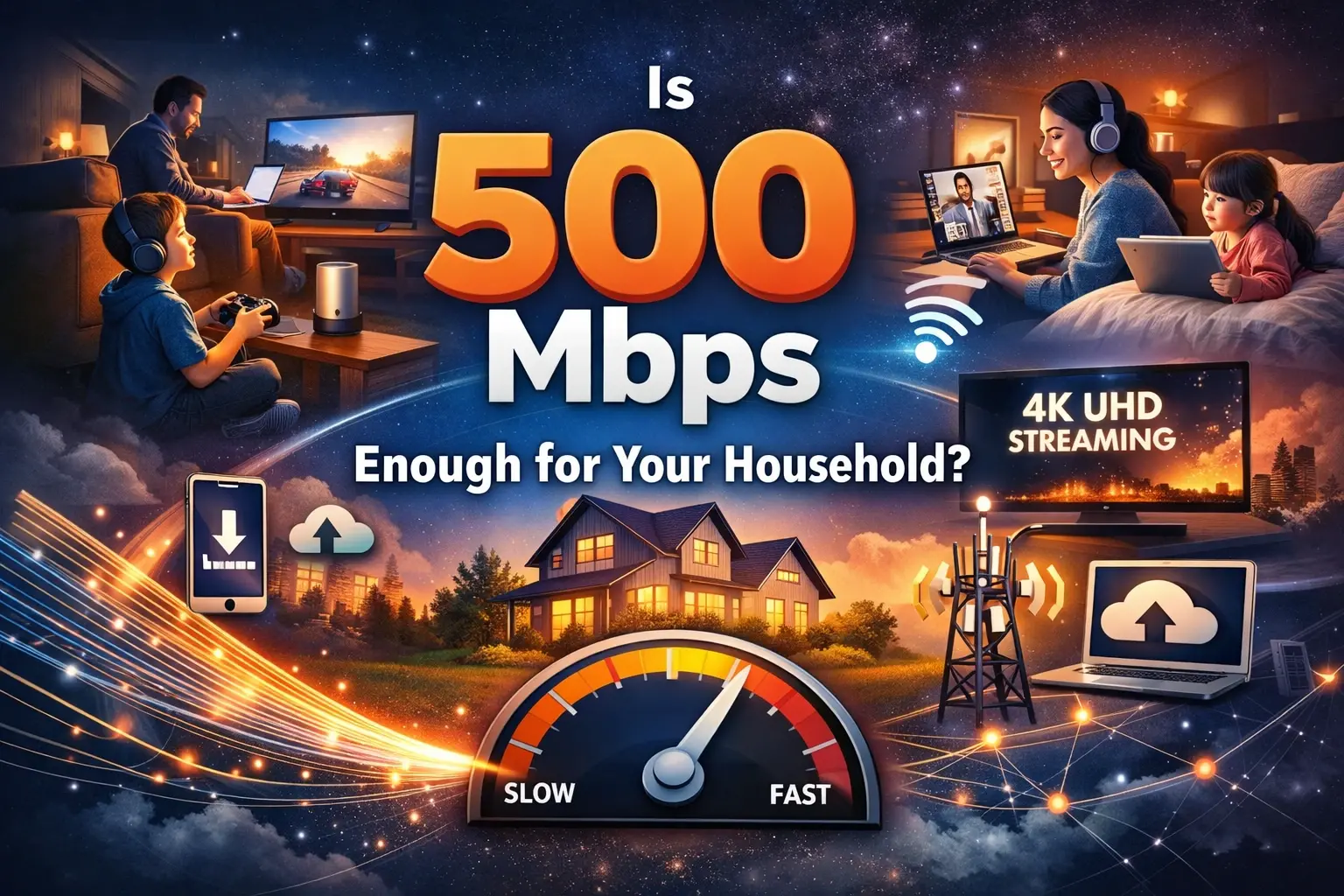
Internet speed shopping has never been more confusing. With ISPs advertising plans ranging from 25 Mbps to 5 Gbps, most households face a genuine question: how much bandwidth do they actually need?
Five hundred megabits per second sits squarely in the middle tier of residential broadband offerings — fast enough to feel premium, yet affordable enough to be widely available. But "fast enough" depends entirely on who lives in your home, how many devices they use, and what they're doing online simultaneously.
This analysis draws from FCC broadband data, Ookla speed research, and consumer technology usage trends to provide a straightforward, evidence-based answer to one of the most common broadband questions in American households.
For most households, 500 Mbps is more than sufficient. A family of four using a mix of 4K streaming, video calls, online gaming, and general browsing will typically consume between 100–200 Mbps of simultaneous bandwidth under real-world conditions. 500 Mbps provides a comfortable margin above that threshold, ensuring consistent performance even during peak usage hours. Households with five or more heavy users, smart home ecosystems, or frequent large file transfers may benefit from upgrading to gigabit service.
Household Profile | Recommended Speed | Is 500 Mbps Sufficient? |
|---|---|---|
Single user (basic browsing + streaming) | 25–100 Mbps | Yes — significantly more than needed |
Couple (streaming + remote work) | 100–200 Mbps | Yes — comfortably covered |
Family of 3–4 (mixed heavy use) | 200–400 Mbps | Yes — with overhead to spare |
Household of 5+ (power users) | 400–800 Mbps | Borderline — may want a gigabit |
Remote work + 4K streaming + gaming | 200–400 Mbps | Yes — well within range |
Smart home with 20+ connected devices | 300–500 Mbps | Yes — at the upper threshold |
How Much Bandwidth Do Common Activities Actually Use?
Understanding real bandwidth consumption is the foundation for any meaningful internet speed decision. Unlike advertised speeds, which represent theoretical maximums, real-world usage is a function of activity type, device count, and simultaneous connections.
Streaming Video Netflix recommends 15 Mbps for 4K Ultra HD streaming per device. Amazon Prime Video and Disney+ operate on similar requirements. Three simultaneous 4K streams would consume approximately 45 Mbps — a small fraction of a 500 Mbps plan.
Video Conferencing Zoom recommends 3.8 Mbps for HD video calls and up to 4 Mbps for 1080p group calls. Even a household with three people on separate video calls simultaneously would consume less than 15 Mbps for video conferencing alone.
Online Gaming Contrary to popular belief, online gaming is not particularly bandwidth-intensive. Most gaming platforms — PlayStation Network, Xbox Live, Steam — require only 3–6 Mbps for active gameplay. However, game downloads can spike temporary usage significantly, with modern titles ranging from 50 GB to 150 GB per download.
Remote Work and Cloud Applications Standard corporate applications, cloud storage syncing, and VPN connections typically consume between 5–25 Mbps, depending on the tools involved. Video-heavy workflows or large file uploads may push usage higher.
Smart Home Devices. Each connected device — thermostats, security cameras, smart speakers, video doorbells — adds idle bandwidth consumption. A home with 20+ smart devices might consume 10–30 Mbps at baseline simply from background communications and updates.
Calculating Your Household's Actual Bandwidth Needs
A practical formula for estimating household bandwidth requirements:
Count simultaneous users — not total users, but how many are online at the same time during peak hours
Identify the most bandwidth-intensive activity per user — 4K streaming, gaming downloads, video calls
Add device overhead — estimate 1–2 Mbps per smart device in idle state
Apply a 20% buffer — network overhead, ISP fluctuations, and unexpected usage spikes
Example calculation for a family of four:
Parent 1: 4K streaming (15 Mbps)
Parent 2: Video conference call (4 Mbps)
Child 1: Online gaming (5 Mbps)
Child 2: YouTube HD streaming (5 Mbps)
Smart home devices (15 Mbps baseline)
Subtotal: 44 Mbps
20% buffer: ~53 Mbps total
This household would need approximately 53 Mbps to operate smoothly — and 500 Mbps provides nearly ten times that capacity.
Research Insights: What the Data Actually Shows
The Gap Between Perceived and Actual Need
One of the most consistent findings in broadband consumer research is that households dramatically overestimate their actual bandwidth consumption. Ookla's analysis of global internet speed trends consistently shows that median download speeds in the United States have surged well past what the average household utilizes during peak hours.
The FCC's Broadband Data Collection reports that the median U.S. household consumes less than 50 GB of data per day — and bandwidth consumption during simultaneous use rarely exceeds 150–200 Mbps even in actively connected homes.
This creates an important consumer insight: the decision between 500 Mbps and 1 Gbps is rarely about actual performance — it is primarily about future-proofing and peace of mind.
The Multi-Device Reality
Pew Research Center data indicates that the average American household now has more than 20 internet-connected devices. However, having 20 connected devices does not mean 20 devices are actively consuming high bandwidth simultaneously. The vast majority of connected devices — smart TVs on standby, idle tablets, security cameras in low-activity mode — consume fractions of a megabit during passive periods.
The practical peak-usage scenario, even in larger households, involves 4–8 devices actively streaming or communicating at the same time.
Upload Speed: The Often-Overlooked Variable
While download speeds dominate broadband marketing conversations, upload speed has become increasingly critical for remote workers, content creators, and households that rely on video conferencing. Traditional cable internet plans offering 500 Mbps download frequently pair that with upload speeds of only 10–20 Mbps. Fiber-based 500 Mbps plans typically provide symmetrical speeds — 500 Mbps upload and download.
For households with remote workers uploading large files, live streamers, or anyone using cloud backup services, the upload figure matters as much as the download number.
When 500 Mbps May Not Be Enough
While 500 Mbps covers the majority of household scenarios, several use cases push toward gigabit service:
Large households with 6+ simultaneous heavy users. When multiple people are simultaneously video calling, streaming 4K content, and downloading large files, aggregate usage can approach or exceed 300–400 Mbps under peak load, narrowing the performance buffer.
Professional content creation. Video editors, graphic designers, and developers uploading large project files regularly — particularly on cable plans with asymmetric upload speeds — may find upload bottlenecks more limiting than download capacity.
Frequent large game downloads. A household where multiple gamers regularly download 100+ GB titles simultaneously can temporarily saturate even a 500 Mbps connection.
Home-based servers or NAS devices. Households running local media servers, home automation hubs, or network-attached storage with heavy local and remote access demands benefit from higher throughput.
500 Mbps vs. Gigabit: Is the Upgrade Worth It?
The practical performance difference between 500 Mbps and 1 Gbps is imperceptible for most households during normal use. Downloading a 4 GB file takes approximately 64 seconds on 500 Mbps versus 32 seconds at 1 Gbps — a meaningful difference for frequent large downloads, but negligible for general browsing and streaming.
The more relevant consideration is pricing. In most markets, gigabit service is priced at a 20–50% premium over 500 Mbps plans. For households whose actual usage rarely exceeds 200 Mbps, that premium delivers minimal functional benefit.
Consumers researching provider availability and plan comparisons for their specific address can find detailed ISP comparison tools and plan information at CablePapa.com, where speed tier breakdowns by provider and region are regularly updated.
Provider Considerations: Speeds Aren't Created Equal
Advertised speeds and delivered speeds can differ based on several infrastructure factors:
Connection type matters significantly. Cable internet plans advertise 500 Mbps shared bandwidth across neighborhood nodes, which can result in slower real-world speeds during peak evening hours. Fiber optic connections deliver more consistent speeds because bandwidth is dedicated rather than shared at the neighborhood level.
Plan throttling and data caps affect some cable providers, where users who exceed monthly data thresholds see reduced speeds for the remainder of the billing period. Understanding a provider's data cap policy before selecting a plan is essential for households with high monthly usage.
Router and in-home network performance can limit effective speeds regardless of the plan tier. A 500 Mbps plan connected to an aging router with Wi-Fi 5 (802.11ac) technology may not deliver consistent speeds throughout a larger home. Wi-Fi 6 and Wi-Fi 6E routers significantly improve multi-device performance.
For assistance comparing provider availability by zip code, households can contact CablePapa directly at (855) 210-8090.
Future-Proofing Considerations
Bandwidth consumption trends upward year over year. Several emerging technologies will increase typical household usage over the next 3–5 years:
8K streaming — While adoption is nascent, 8K content requires an estimated 50–100 Mbps per stream
Extended Reality (XR) applications — Augmented and virtual reality applications in development require 50–200 Mbps for high-quality real-time rendering
AI-powered home devices — Next-generation smart home ecosystems will increasingly rely on cloud-based AI processing, increasing device-level bandwidth consumption
Cloud gaming expansion — Services like Xbox Cloud Gaming and NVIDIA GeForce NOW require 15–35 Mbps per session and may become primary gaming platforms
A 500 Mbps connection provides a reasonable buffer for these near-term developments. However, households planning a 5–7 year planning horizon may find that gigabit service offers better long-term value.
FAQ Section
Is 500 Mbps fast enough for a family of 4?
Yes. A family of four engaging in simultaneous 4K streaming, video calls, gaming, and browsing typically consumes between 50–150 Mbps in aggregate during peak usage. 500 Mbps provides substantial overhead, ensuring smooth performance even when all household members are active online simultaneously.
Can 500 Mbps support multiple 4K streams at once?
Absolutely. Netflix requires approximately 15 Mbps per 4K stream. A 500 Mbps connection could theoretically support over 30 simultaneous 4K streams — far more than any household would need.
Is 500 Mbps good for gaming?
Yes, for active gameplay. Online gaming requires only 3–6 Mbps during sessions. However, if multiple gamers in the household are simultaneously downloading large game updates or titles, speeds can be temporarily consumed in larger quantities.
What's the difference between 500 Mbps cable and 500 Mbps fiber?
Both offer the same download speed, but fiber typically provides symmetrical upload speeds (500 Mbps up and down), while cable often offers asymmetric speeds (500 Mbps down, 10–20 Mbps up). Fiber also tends to deliver more consistent speeds because it doesn't share bandwidth at the neighborhood node level.
Do I need 500 Mbps for working from home?
For most remote workers using video conferencing, cloud apps, and general productivity tools, 100 Mbps is sufficient. 500 Mbps provides considerable overhead and is appropriate for households where multiple people work from home simultaneously.
How many devices can 500 Mbps support?
There is no fixed device limit, as it depends on the activity type. In practice, 500 Mbps comfortably supports 20–30+ connected devices with a mix of active and idle usage without noticeable performance degradation.
Is 500 Mbps enough for smart home devices?
Yes. A typical smart home with 15–25 connected devices (thermostats, cameras, speakers, locks) consumes 15–30 Mbps in aggregate. This represents a small fraction of a 500 Mbps connection's capacity.
Should I upgrade from 500 Mbps to 1 Gbps?
Only if your household consistently experiences slowdowns under a 500 Mbps plan, has six or more simultaneous heavy users, or regularly performs large professional file transfers. For most households, the performance difference is negligible.
What upload speed comes with a 500 Mbps plan?
This varies by provider and connection type. Cable providers often offer 10–20 Mbps upload alongside 500 Mbps download. Fiber providers typically offer symmetrical 500 Mbps upload. Remote workers and content creators should verify upload speeds before selecting a plan.
How do I know if 500 Mbps is available at my address?
Provider availability varies significantly by location. Consumers can check availability by zip code through their ISP's website or by contacting a broadband comparison service. CablePapa.com provides provider and plan availability tools for residential addresses across the U.S.
Conclusion
For the overwhelming majority of American households, 500 Mbps represents more than adequate broadband service. Real-world bandwidth consumption data consistently shows that even actively connected households with multiple simultaneous users rarely approach 200 Mbps in aggregate usage — leaving 500 Mbps plans with substantial performance headroom.
The decision to upgrade beyond 500 Mbps should be driven by demonstrated usage needs — observed slowdowns during peak hours, specific professional requirements, or large household size — rather than marketing-driven assumptions about speed requirements.
Consumers evaluating their options are encouraged to review provider availability and plan comparisons at CablePapa.com, where research tools help households match their actual usage profile to appropriate plan tiers.
📚Read More Articles About Internet Providers
How to Get Cheap Internet in Texas That's Actually Reliable
September 7, 2026
How Do I Know If I Can Get Fiber Internet? A Step-by-Step Availability Guide
August 24, 2026
Verizon Fios vs. AT&T Fiber: Which Fiber Internet Is Better in 2026?
August 3, 2026