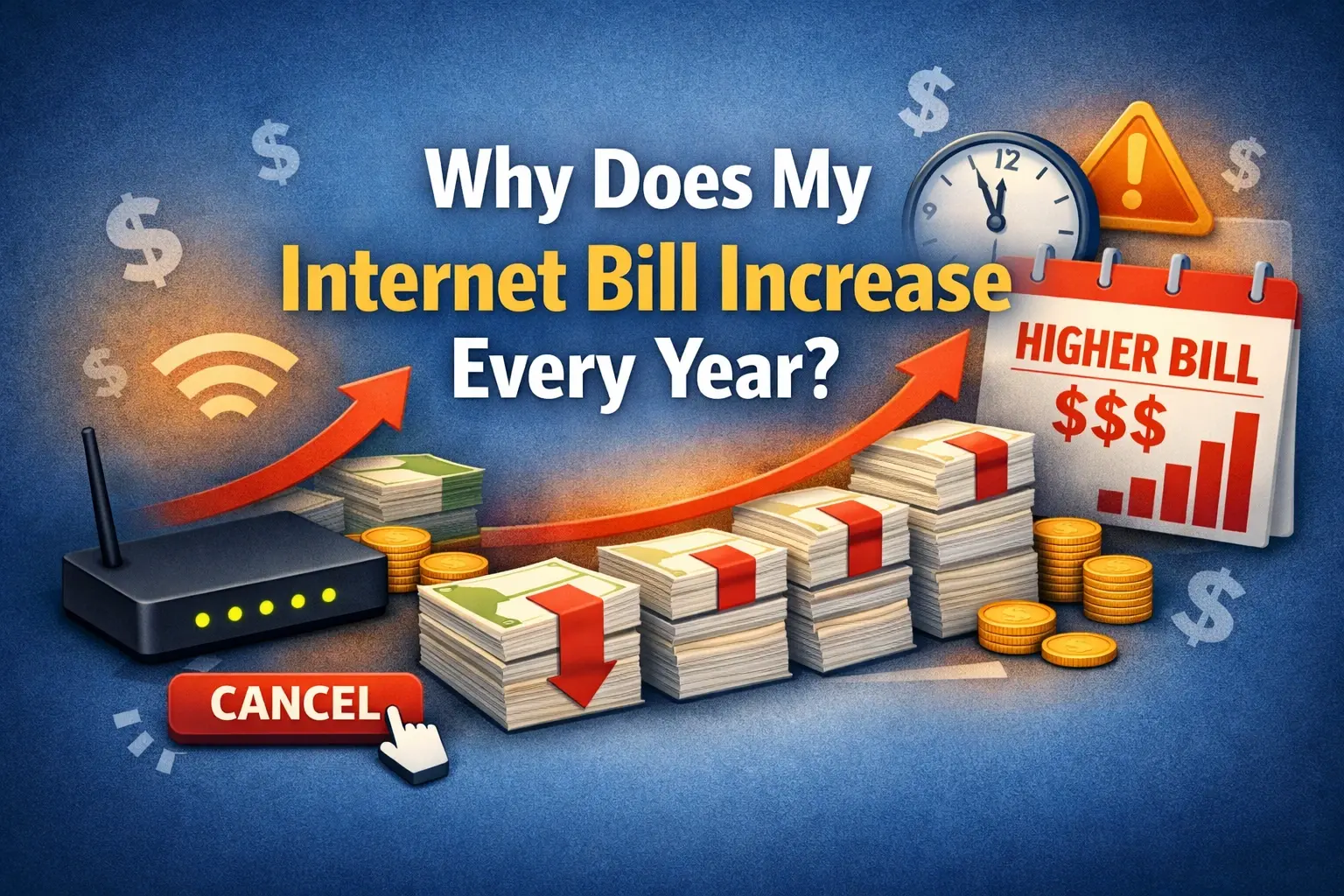
Internet bills increase every year for several interconnected reasons: promotional pricing expires and reverts to much higher standard rates, providers apply annual price adjustment clauses buried in contracts, infrastructure and content carriage costs rise and are passed to consumers, and limited competition in most U.S. markets reduces pressure on ISPs to hold prices steady. According to a 2025 Reviews.org survey, internet bills rose by an average of $20.78 per month in 2024 alone, and 84% of Americans experienced at least one internet or home service price increase that year.
Key Findings
Cause of Increase | Typical Impact | Applies to |
|---|---|---|
Promotional rate expiration | $20–$50/month jump after 12–24 months | Most major ISPs |
Annual price adjustment clause | $5–$15/year within existing contracts | Comcast, Charter, Cox, others |
Equipment rental fee increases | $1–$5/year | Cable ISPs with modem rental |
Broadcast and content carriage fees | $3–$20/year | TV bundle subscribers |
End of Affordable Connectivity Program (ACP) | $30/month removed for ~23M households | Low-income households (May 2024) |
Market-wide Internet Price Index increase | 7.8% (June 2022–June 2024) | Broadband market broadly |
Xfinity 2025 general rate increase | ~5% internet, 12–15% TV | Xfinity customers |
Introduction
For most American households, the monthly internet bill is one of those charges that quietly grows year after year — often without a clear explanation, a formal notification, or any change in the service being delivered. One month, the bill is $49.99. Twelve months later, it's $74.99. Two years later, it's pushing $90. And yet nothing about the plan, speed, or equipment has changed.
This experience is not coincidental, and it is not the result of forces beyond the control of providers. Internet price increases follow predictable patterns that are structurally embedded into the way major ISPs sell, contract, and retain customers. Understanding those patterns is the first step toward doing something about them.
A 2025 Reviews.org survey found that internet bills rose by an average of $20.78 per month in 2024, and that 84% of Americans experienced an internet or home service price increase that year. Nearly 75% of respondents canceled, downgraded, or at minimum considered switching providers in response. The frustration is widespread — and the causes are identifiable.
This article examines every mechanism through which internet bills increase year over year, places those increases in the context of broader market and regulatory dynamics, and provides a practical framework for consumers who want to push back.
Reason 1: Your Promotional Rate Expired
The most common — and most impactful — cause of a sudden internet bill increase is the expiration of a promotional introductory rate.
The economics of ISP customer acquisition run on promotional pricing. New customers are offered significant discounts for an initial period, typically 12 to 24 months, to lower the barrier to switching. Once that period ends, the account automatically reverts to the provider's standard rate, which is almost always $20 to $50 per month higher than the promotional rate — and sometimes more.
As Peter Holslin, managing editor of Reviews.org, explained: "Many internet providers entice new customers with 'promotional' rates that then increase to a 'standard' rate once the promotional period comes to an end — usually after the first 12 months, but sometimes sooner."
This transition is disclosed in the terms of service and, in many cases, on the FCC-mandated broadband label introduced in April 2024. But it is rarely communicated proactively. Most customers discover the increase when the higher charge appears on their bill, not in advance of it.
The gap between promotional and standard rates has widened over time as providers have become more aggressive with initial discounts to compete for new customers while relying on inertia to retain subscribers at full price. A U.S. News & World Report survey of 2,500 adults found that the average internet bill had increased from $81 at the time of sign-up to $98 at the time of the survey — an increase of $17 per month that tracked closely with the promotional-to-standard rate transition.
What this means for consumers: Every internet plan with a promotional rate has an expiration date. The standard rate applies from that date forward unless the customer takes action — either by negotiating a new promotional rate, switching providers, or escalating to a retention team.
Reason 2: Annual Price Adjustment Clauses
Separate from promotional rate expirations, many internet service agreements include annual price adjustment clauses that allow providers to raise rates even within an existing contract period — and even for customers who never signed up for a promotional rate.
These clauses are standard across the industry and are disclosed in the terms of service, typically in dense legal language that few customers read in full. They generally allow the provider to raise monthly rates by a specified amount — often $5 to $15 — once per year, with notice delivered by email, bill insert, or notice on the provider's website.
Comcast Xfinity has increased prices annually for more than 14 consecutive years, according to industry tracking. The 2025 Xfinity price increase, effective January 1, 2025, raised internet rates by approximately 5% and TV packages by 12–15%, with TV equipment, regional sports fees, and broadcast fees increasing by an average of 19% year over year.
Customers who were already past their promotional period and paying standard rates still saw their bills increase at the start of 2025 — not because of any expiring promotion, but because the annual adjustment clause allowed Xfinity to raise prices unilaterally. Many of these customers reported receiving no proactive notification: as one Xfinity customer noted in a community forum, "This was not communicated to me. I saw no alert on my billing statement, no email notice, and no banner in the Xfinity app."
Charter Spectrum, Cox, and other major cable ISPs operate similar annual adjustment structures. The absence of contracts with Spectrum — the provider does not require long-term agreements — means customers can leave at any time, but it does not mean rates are stable. Prices increase annually regardless of contract status.
Reason 3: Content and Carriage Cost Increases
For customers with TV bundles — or internet plans that include access to streaming services as part of the package — content and carriage cost increases are a significant and growing driver of annual bill increases.
Cable providers pay retransmission fees to local broadcast networks (ABC, CBS, NBC, FOX) and carriage fees to cable networks for the right to include those channels in their packages. These fees are subject to periodic renegotiation, and the costs have risen substantially over the past decade. Providers pass these costs on to customers through a combination of direct price increases and growing broadcast TV surcharges.
In December 2025, Xfinity raised certain TV prices specifically because of "increased costs television network owners charge us for the content and shows you enjoy." The Xfinity StreamSaver subscription, which bundles access to Peacock, Netflix, and Apple TV+, increased from $15 per month to $18 per month starting December 22, 2025. These adjustments reflected both rising carriage fees and escalating streaming licensing costs.
Carriage disputes — when a provider and a network owner fail to agree on fees, resulting in channels being temporarily removed from the lineup — have become increasingly common. Xfinity alone was involved in multiple carriage disputes in 2025, including disputes with regional sports networks and Disney. When these disputes are resolved, the settlement terms typically result in higher content fees that are passed through to customers.
Customers who subscribe to internet-only plans are not immune. Content cost pressures influence overall pricing strategies at cable ISPs that generate significant revenue from bundled services. When content costs rise faster than expected, providers often make up the margin through internet price adjustments to offset the impact.
Reason 4: Infrastructure Investment Costs
ISPs consistently cite infrastructure investment as a justification for price increases, and the costs are real — though the relationship between investment and consumer pricing is contested.
Comcast reported growing connectivity revenue by 5.7% to $45.1 billion in 2024 while simultaneously continuing a multi-year broadband network upgrade designed to deliver multi-gigabit symmetrical speeds. According to USTelecom's 2025 Broadband Pricing Index, industry-wide infrastructure investment reached $89.6 billion in the previous year.
Fiber expansion — by AT&T, Frontier, Lumen, and regional providers — requires significant capital. Fixed wireless buildout by T-Mobile and Verizon Home Internet also involves ongoing network investment. Providers argue that these costs must be recovered through pricing.
The counterargument, supported by FCC data, is that when measured against the speeds delivered, the cost of internet service has declined substantially in real terms. The FCC's 2024 Section 706 Report found that while nominal internet prices increased by 11% from 2009 to 2023, this was below the 37% increase in overall consumer prices during the same period — meaning broadband prices fell by approximately 19% in inflation-adjusted terms over that 14-year span. BroadbandNow data similarly shows that inflation-adjusted fiber broadband prices have fallen 39% since 2015.
The tension for consumers is that while the long-run trajectory of broadband pricing is downward in real terms, the short-run experience — particularly for cable internet subscribers on legacy infrastructure — has been upward in nominal terms since 2022. The Technology Policy Institute found that the Internet Price Index jumped by 7.8% between June 2022 and June 2024, surpassing the 6% increase in the overall Consumer Price Index during the same period. For customers focused on their current bill, the long-run trend offers limited comfort.
Reason 5: Limited Market Competition
Infrastructure costs and content fees are contributing factors to internet price increases, but the market dynamic that enables providers to pass those costs on with minimal subscriber loss is limited competition.
A 2025 analysis found that meaningful competition for high-speed internet (100+ Mbps service) is absent in more than 96% of U.S. counties. In most markets, consumers have one or two realistic options for broadband service above basic speeds. When switching is costly, inconvenient, or simply not available because no alternative provider covers the address, ISPs face limited competitive pressure to hold prices steady.
The American Customer Satisfaction Index (ACSI) consistently gives ISPs among the lowest consumer satisfaction scores across all tracked industries. Customer frustration with pricing is high. But without viable alternatives, frustration does not translate into market pressure on providers.
This dynamic is shifting in some markets. Fiber internet is expanding rapidly in areas previously served only by cable. Fixed wireless carriers like T-Mobile Home Internet have introduced competitive flat-rate pricing in suburban and some rural markets. Municipal broadband networks — operated by utilities and cooperatives in cities including Chattanooga, Tennessee, and various markets in New York — have demonstrated that gigabit service can be delivered at $60 to $75 per month when the pricing model is not structured around promotional acquisition and annual rate increases.
In Consumer Reports' 2024 survey, small fiber providers such as EPB Chattanooga, Greenlight (NY), Allo, Sonic, and Google Fiber topped customer satisfaction ratings — a pattern that reflects both the performance advantages of fiber infrastructure and the pricing transparency that competitive or community-owned providers tend to offer.
For consumers in markets where competition is increasing, the leverage to negotiate or switch is real. For consumers in monopoly or duopoly markets, the structural constraint is significant — though not absolute.
Reason 6: The End of the Affordable Connectivity Program
For approximately 23 million lower-income households, the single largest cause of an internet bill increase in recent years was not a provider price hike — it was the end of the Affordable Connectivity Program (ACP) in May 2024.
The ACP provided a $30 per month subsidy (up to $75 in qualifying tribal areas) toward internet service for eligible low-income households. When full funding for the program lapsed in May 2024, the subsidy ended abruptly, and participating households saw their effective internet cost increase by $30 per month overnight — with no change in the service plan itself.
Eighty-seven percent of respondents in the U.S. News & World Report survey wanted Congress to reinstate the ACP, and 76% expressed support for government-imposed price caps on ISP charges. As of early 2026, no replacement program had been enacted at the federal level, though some states and municipalities have launched localized programs.
The end of the ACP illustrates an important dynamic: internet bill increases are not always driven by provider decisions. Subsidies, tax structures, and regulatory programs all influence the effective cost of service, and changes to those programs can produce bill increases that are entirely outside the provider's billing structure.
Research Insights: Why Annual Increases Are Structurally Persistent
The annual internet price increase is not a malfunction of the market — it is a feature of the way the broadband business model is structured. Understanding this prevents consumers from being surprised and helps them engage with providers from a more informed position.
Several structural factors make annual increases persistent rather than episodic:
Subscriber Inertia Is Priced In ISPs' model churn rates — the percentage of customers who leave each year — when setting pricing strategies. If a provider knows that 90% of customers will absorb a $10 annual increase without canceling, the increase generates net revenue even accounting for the 10% who leave. Retention costs are lower than acquisition costs: industry estimates suggest ISPs spend $250 to $400 to acquire a new customer, making it economically rational to offer significant discounts to retain customers who call to cancel while raising prices on the majority who don't.
Standard Rates Are the Revenue Engine. Promotional rates are an acquisition tool, not a revenue model. The standard rate — the higher price a customer pays after the promotional period expires — is where ISPs generate margin. Annual adjustments to that standard rate compound over time, expanding the gap between what customers pay and what they expected to pay when they first signed up.
Fee Structures Supplement Rate Increases Annual price adjustments are often supplemented by fee increases that fly beneath the headline rate. Equipment rental fees, broadcast TV surcharges, and service fees can all increase independently of the base plan rate, adding to the total monthly bill without triggering the same level of customer scrutiny that a headline rate change would.
Transparency Weakens Rather Than Strengthens The FCC's October 2025 proposal to roll back several broadband label disclosure requirements — including removing the machine-readable format requirement and reducing the archive period for labels — signals that regulatory pressure for pricing transparency is currently decreasing rather than increasing. In a less transparent environment, consumers have less information available to compare true costs across providers, reducing the competitive pressure on incumbents.
How to Stop Your Internet Bill From Increasing
Understanding why bills increase is useful. Acting on that understanding is more so. The strategies below range from immediately actionable to requiring a longer-term commitment, but each addresses one or more of the mechanisms described above.
Step 1: Know When Your Promotional Rate Ends
If you are currently on a promotional rate, find out exactly when it expires and what the standard rate will be at that point. This information should be on your broadband label, in your original contract, and available from customer service.
Set a calendar reminder for 60 days before the promotional period ends. This gives you time to negotiate a renewal, research alternatives, and make a deliberate decision rather than a reactive one when the higher rate appears on your bill.
Step 2: Call the Retention Department — Not General Customer Service
When you contact your provider about a price increase, ask immediately to be transferred to the customer retention or loyalty department. These teams have the authority to offer discounts, promotional rates, and fee waivers that front-line customer service representatives do not.
Research competing offers in your area before you call. Knowing that a competitor is offering comparable speeds at a lower price gives you a specific data point to reference rather than a general complaint. Mention competitor pricing and ask the retention team to match or improve on it. BroadbandNow data and comparison tools at CablePapa.com can help you identify what's available at your address before you make that call — or you can reach (855) 210-8090 for a personalized comparison from an advisor.
Most customers who call Spectrum's retention department, for example, save $20 to $40 per month, according to independent analysis. ISPs spend $250 to $400 to acquire a new customer, which makes retaining an existing one economically important — and retention teams are authorized to offer meaningful discounts to customers who demonstrate a credible intent to leave.
Step 3: Negotiate With Specific Language
The phrasing of your negotiation request matters. Rather than asking "Can you lower my bill?", frame the conversation around a specific competitor offer and a specific ask:
"I've been a customer for [X years]. My current plan is [plan name] at [current rate], and I've been looking at [competitor] offering [speed] for [price] per month. I'd like to stay with you, but I need my rate to be competitive with that. What can you offer me?"
Retention specialists respond to customers who present themselves as informed and prepared to leave. Vague complaints about a bill being "too high" are less effective than a specific competitor comparison and a request to match it.
Step 4: Buy Your Own Modem
If you are currently paying a monthly equipment rental fee — typically $10 to $15 per month — purchasing a provider-certified modem eliminates that cost. The upfront cost of $80 to $150 for a quality device pays for itself within one year and removes one of the fee categories most likely to increase annually.
Verify compatibility with your provider before purchasing. Most major ISPs maintain a list of approved third-party modems that customers can use in place of rented equipment.
Step 5: Compare Alternatives Before Assuming You Have None
Many consumers operate under the assumption that they have only one real option for broadband in their area. This assumption is increasingly incorrect in markets where fiber expansion and fixed wireless growth have created new competitive choices.
Fiber internet providers tend to offer simpler pricing structures with fewer promotional traps. Fixed wireless carriers like T-Mobile Home Internet have introduced flat-rate, no-contract plans in many suburban markets. To see what's genuinely available at your specific address — rather than what a provider's coverage map claims — use a tool that checks actual service availability by address.
CablePapa.com provides real-time provider availability and plan comparison by address. For a direct conversation with an advisor who can walk through current options and pricing in your area, call (855) 210-8090.
Step 6: Consider a Price-Lock Plan
Some providers now offer plans with extended price guarantees — Xfinity's 5-Year Price Guarantee, for example, locks in the base monthly rate for five years with no annual contract. These plans typically carry a higher monthly rate in year one compared to a promotional introductory offer, but independent analysis has found that the total cost over five years is often lower once post-promotional rate increases and annual adjustments are factored in.
If you value billing predictability and intend to stay with a provider long-term, a price-lock plan eliminates the annual renegotiation cycle at the cost of less flexibility to switch.
Step 7: File a Complaint if Increases Were Not Disclosed
If you believe your internet bill increased in ways that were not disclosed at the time of sign-up, you have regulatory options. The FCC's Consumer Complaint Center (consumercomplaints.fcc.gov) accepts complaints about billing practices. Your state public utility commission may also have jurisdiction over ISP billing practices in some states.
Filing a complaint creates a regulatory record and often prompts a faster resolution from the provider than a standard customer service call. It also contributes to the dataset that informs regulatory decisions about disclosure requirements.
Consumer Impact: The Real Cost of Annual Increases Over Time
Annual internet price increases compound over time in ways that are easy to underestimate at the point of sign-up.
A 2025 BroadbandSearch analysis illustrated this clearly: starting with a $50-per-month internet plan and applying annual increases consistent with observed market patterns, the five-year total cost can exceed $5,000 — more than double the estimate a consumer might make at sign-up. Cable rate increases through 2024 and 2025 averaged $8 to $12 per month annually, and these compound the five-year total further.
J.D. Power's tracking of average internet costs captures this trajectory in real numbers. The average monthly cost for unbundled wired internet reached $83.35 through February 2025, up from $82.96 in November 2024 — and up $7.93 from February 2024 figures. The average wired internet bundle costs $170.06 per month through February 2025, up $7.93 from the same period the prior year.
For the 39% of U.S. adults who pay for home internet and have cut personal expenses to cover the bill — a figure from a U.S. News & World Report survey of 3,500 respondents — these year-over-year increases are not an abstract inconvenience. They represent a recurring compression of household budgets for a service that has become as essential as electricity or running water.
Future Outlook
The broadband pricing landscape is in genuine transition, and the trajectory is not uniformly upward.
Fiber Competition is creating price pressure on cable incumbents in an expanding number of markets. As fiber reaches more addresses, the realistic alternative to cable has improved — both in terms of performance and pricing transparency. The presence of fiber competition has historically led to more competitive offers from incumbent cable providers in the markets where it exists.
Fixed Wireless Growth from T-Mobile and Verizon has demonstrated that flat-rate, no-contract internet at $50 to $60 per month is commercially viable at scale. This pricing model — which does not rely on promotional-to-standard rate transitions — is pressuring traditional ISPs in suburban and some rural markets.
State-Level Consumer Protections are an active and evolving area. Several states are considering or have enacted legislation requiring greater fee transparency, advance notice of price increases, and clearer disclosure of post-promotional rates at the point of sale.
AI-Enabled Negotiation Tools are an emerging category. Services that automate the negotiation process — monitoring bills for increases and contacting retention departments on behalf of customers — are beginning to demonstrate meaningful results. As these tools become more widely used, the negotiation skills that currently separate informed customers from the general population may become more democratically accessible.
For consumers navigating these dynamics right now, the most important variable is awareness: knowing that increases are structural and predictable, and that the tools to mitigate them exist and work.
Frequently Asked Questions
Why did my internet bill go up without any notice?
Most ISPs include annual price adjustment clauses in their service agreements that allow them to raise rates without individual notification beyond a general notice period. Xfinity, for example, adjusts prices on January 1 each year and is required to notify customers within 30 days. However, many customers report not receiving proactive emails or in-app notifications. If your rate changed unexpectedly, request an itemized breakdown from your provider and ask specifically which clause authorized the increase.
How much do internet bills typically increase each year?
Annual internet bill increases vary by provider, plan, and region. Reviews.org's 2025 State of Consumer Trust Survey found that internet bills rose by an average of $20.78 per month in 2024 — one of the largest single-year increases in recent memory. The Technology Policy Institute found that the Internet Price Index rose 7.8% between June 2022 and June 2024, outpacing the general Consumer Price Index increase of 6% over the same period. Typical annual adjustment clauses add $5 to $15 per month per year.
Can I negotiate my internet bill down after a price increase?
Yes. Negotiation is both feasible and frequently effective. Most ISPs spend $250 to $400 to acquire a new customer, making retention economically valuable. Customers who call the retention department — not general customer service — and present a specific competitor offer are often offered discounts of $20 to $40 per month, extended promotional pricing, or waived fees. Success rates are highest when the customer demonstrates credible intent to switch providers.
What is the best time to call and negotiate my internet bill?
Research suggests the best time to call is late afternoon, toward the end of the month, when retention agents are under pressure to meet monthly retention quotas. Calling 60 days before your promotional period ends also gives you maximum leverage — you have options, time to compare alternatives, and a credible reason to request a better rate.
Is it worth switching internet providers to get a lower bill?
Switching providers — particularly from a cable ISP to a fiber or fixed wireless provider — can produce meaningful long-term savings, especially in markets where new competitors offer flat-rate pricing without promotional periods. The key calculation is total cost of ownership: compare the new provider's post-promotional standard rate, any equipment fees, and installation costs against your current total bill. CablePapa.com allows you to compare plans available at your address, or you can call (855) 210-8090 to speak with an advisor.
Do fiber internet providers raise prices less often than cable providers?
Generally, fiber providers and fixed wireless carriers have demonstrated more pricing stability, and several offer no-annual-increase guarantees or flat-rate plans. However, fiber providers are not immune to price increases — particularly those that were acquired by larger carriers or that offer bundled services with content carriage costs. The pricing model matters more than the technology: month-to-month flat-rate plans with no promotional periods tend to be more predictable regardless of delivery technology.
What happened to the Affordable Connectivity Program, and how does it affect my bill?
The Affordable Connectivity Program (ACP) provided a $30 per month subsidy for eligible low-income households. The program's full funding lapsed in May 2024, effectively ending the subsidy for approximately 23 million households. For participating households, this was a $30 per month bill increase with no change in service. Congress had not enacted a replacement program as of early 2026, though several state and municipal programs have launched in the interim.
What is a price-lock internet plan, and is it worth it?
A price-lock plan is an internet plan that guarantees the base monthly rate will not increase for a specified period — typically two to five years. Xfinity's 5-Year Price Guarantee is a current example. These plans typically carry a higher initial monthly rate than a promotional introductory offer, but independent analysis has found the total five-year cost is often lower because the promotional-to-standard rate jump is avoided. For households that value billing predictability and plan to stay with one provider long-term, a price-lock plan eliminates the annual negotiation cycle.
Conclusion
Internet bill increases are not random, unpredictable events. They follow a consistent pattern: promotional rates expire, annual adjustment clauses take effect, content carriage costs rise and are passed through, and the structural absence of competition in most markets limits the incentive for providers to hold prices flat.
Understanding these mechanisms does not make the increases disappear, but it changes how a consumer engages with them. A customer who knows their promotional period ends in March, has researched what competitors are offering at their address, and calls the retention department prepared to cite specific alternatives is in a fundamentally different position than a customer who opens a higher bill and calls to complain without a plan.
The most effective combination is preparation, timing, and credible leverage. Providers spend hundreds of dollars acquiring each new customer — which means they have strong financial reasons to retain an existing one at a modest discount rather than lose them entirely.
For consumers who want to understand exactly what options are available at their address — and what those options actually cost after fees and promotional periods — CablePapa.com provides current provider and plan data for comparison. Or call (855) 210-8090 to speak with an advisor who can walk through the specifics of your market.