Best Internet Providers for Apartments in 2026
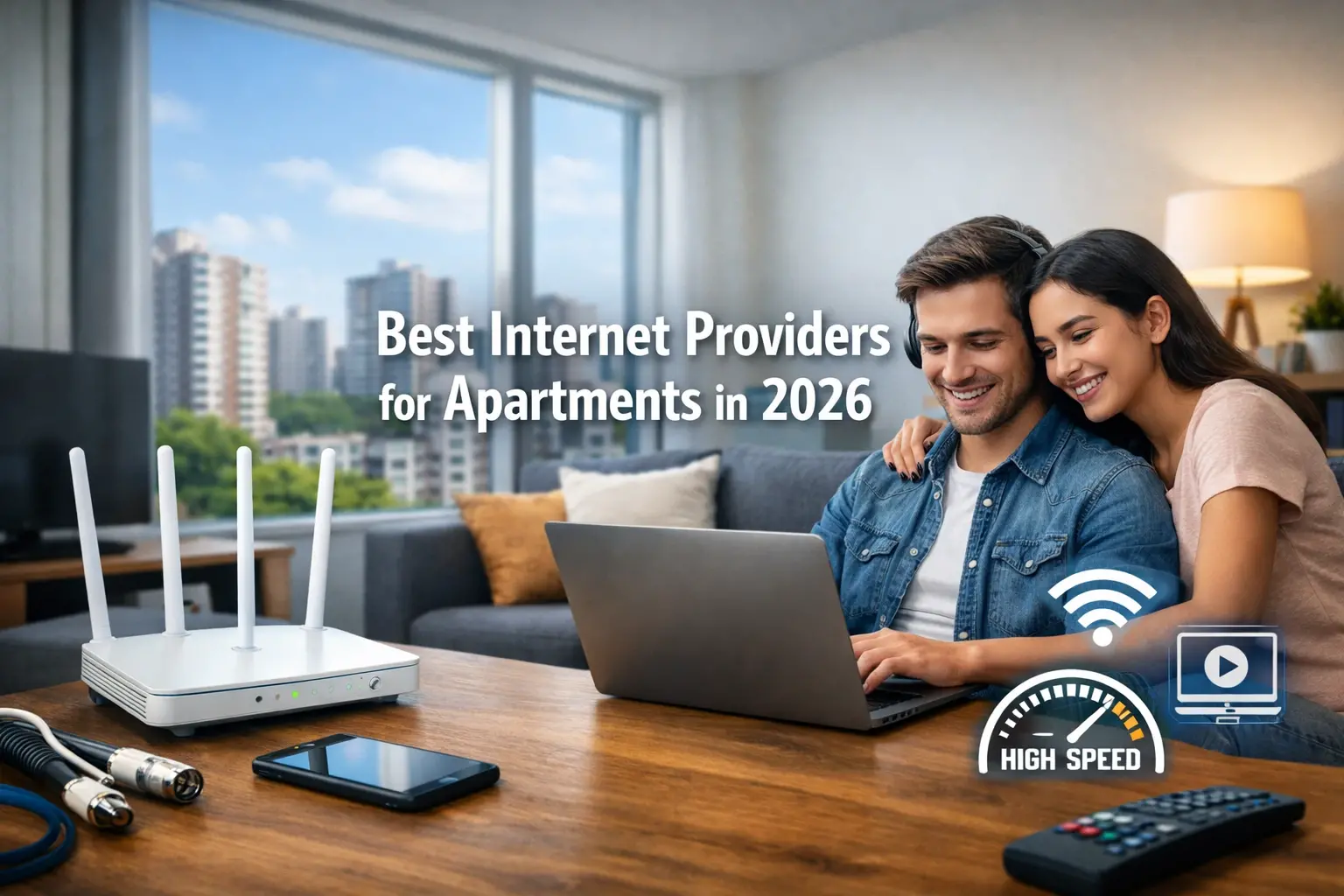
Renting changes the internet shopping equation. A homeowner can pick any provider serving their street and schedule whatever installation they want. An apartment resident is working within someone else's walls — literally. Building wiring, landlord permission, lease length, and shared infrastructure all narrow the field before price ever enters the conversation.
This guide breaks down what actually determines internet quality and availability in apartments, what independent research and federal broadband policy say about renters' rights and options, and which types of providers tend to serve apartment living best in 2026.
Quick Answer
The best internet provider for an apartment depends primarily on what's already wired into the building. If fiber is available, providers like AT&T Fiber or Verizon Fios generally offer the best combination of speed and reliability. If only cable is wired in, Spectrum, Xfinity, or Cox are typically the strongest no-contract options. For renters who want to avoid installation entirely — or who move frequently — 5G home internet from T-Mobile or Verizon requires no wiring, no drilling, and no landlord approval, making it the most flexible choice even if peak-hour speeds can be less consistent than a wired connection.
Key Findings
Building infrastructure, not provider marketing, is the real constraint: most apartments are pre-wired for either coaxial cable or fiber, but rarely both, which means your unit's available providers may differ from a neighbor's building down the street.
Federal broadband policy has changed the bar for what counts as adequate service. The FCC raised its official broadband benchmark to 100 Mbps download and 20 Mbps upload speeds in 2024, a fourfold increase from the previous 25/3 Mbps standard set in 2015.
Renters have more protection against being locked into a single provider than many assume: the FCC adopted rules in 2022 prohibiting broadband providers from entering into exclusive revenue-sharing agreements with owners of multi-tenant buildings.
Cable remains the most commonly available wired option in apartment buildings, with major providers delivering plans that typically start in the $30–$40 range for entry-level speed tiers.
Fixed wireless 5G home internet has emerged as the standout option for renters who move often or whose leases restrict installation, since the equipment is self-installed and portable between addresses.
Shared infrastructure is a real performance factor in apartments: cable connections run through a building's main line, and a single cable node can serve dozens of households, so evening speeds may dip below advertised rates during peak usage hours.
Why Apartment Internet Shopping Works Differently
The single most important fact for any renter to understand is that a provider's presence in your city doesn't guarantee it serves your specific unit. Apartment buildings are typically pre-wired for one type of infrastructure — coaxial cable, fiber, or occasionally both in newer construction — and that wiring, not the provider's national coverage map, determines what's actually available to you. The most reliable way to find out is to check wall outlets for coaxial jacks or fiber/ethernet ports, ask the leasing office directly which providers are wired into the building, and run an address-specific availability check (including your exact unit number) on each provider's website, since options can vary unit to unit within the same building.
The Three Realistic Categories of Apartment Internet
Cable internet remains the most widely available wired option in urban apartment buildings. It's generally affordable, with typical introductory rates in the $30–$40 range for speed tiers in the 300–400 Mbps range, and providers like Spectrum, Xfinity, and Cox all offer no-contract plans well suited to lease terms that don't run a full year. The trade-off is shared infrastructure: because a single cable node serves many households in the same building or block, evening and weekend congestion can noticeably reduce real-world speeds compared to what's advertised.
Fiber internet is the second-most available wired connection type in urban markets and offers a meaningful upgrade where it exists: symmetrical upload and download speeds, lower latency, and infrastructure that isn't shared the way cable nodes are. Providers such as AT&T Fiber and Verizon Fios are generally considered the gold standard where they reach a building, though fiber build-out to individual apartment units still lags cable in many markets.
Fixed wireless 5G home internet — led by providers like T-Mobile Home Internet — sidesteps the building-wiring problem entirely. The equipment is a self-install gateway that sits near a window and connects to nearby cell towers, requiring no drilling, no professional installation appointment, and no landlord sign-off. That makes it the most renter-friendly option on paper, though performance depends heavily on tower proximity and can be less consistent in dense urban buildings where thick walls or crowded network conditions interfere with signal strength.
What Renters Should Know About Their Rights
Multi-tenant buildings have historically been a soft spot for competition: more than a third of the U.S. population lives in a condo or apartment building, and for years many of those residents had only one realistic broadband option because of exclusive agreements between building owners and a single provider. The FCC addressed this directly, adopting rules that prohibit broadband providers from entering into exclusive revenue-sharing agreements with multi-tenant building owners — a move regulators framed as necessary because roughly a third of the country lives in buildings where residents often cannot shop around for a better deal. That doesn't guarantee every building has multiple wired providers today, since wiring installation itself is expensive and not mandated, but it does mean landlords generally cannot legally block competing providers from marketing to tenants through exclusive deals.
Renters should also watch for bulk billing arrangements, where internet is included in rent, and the building has pre-selected the provider on residents' behalf. These arrangements can be convenient but may limit choice, so it's worth asking during the leasing process whether internet is bulk-billed and, if so, what specific plan and speed tier is included.
Research Insights
A few patterns emerge that go beyond simply ranking providers by price.
The FCC's updated speed benchmark reframes what "good enough" means for apartment shoppers. With the broadband standard moved to 100 Mbps download and 20 Mbps upload as of 2024, a plan that felt adequate under the old 25/3 Mbps definition may now fall short of federal guidance, particularly for multi-person households running video calls, streaming, and remote work simultaneously. Renters comparing plans should treat 100/20 Mbps as a practical floor rather than a stretch goal, especially in shared-occupancy apartments.
Shared infrastructure is an underrated variable in the fiber-versus-cable decision. Two apartments advertising the same top-line speed can perform very differently in practice if one runs on fiber (dedicated bandwidth to the unit) and the other on cable (bandwidth shared across a neighborhood node). This matters most in larger buildings and during predictable peak windows — evenings and weekends — when everyone on the same node is online at once.
5G home internet's real value for renters isn't speed; it's optionality. Wired connections generally still outperform fixed wireless on consistency, but the ability to activate service same-day without a technician visit, avoid landlord approval entirely, and take the equipment to a new address at lease-end addresses friction points that matter more to renters than to homeowners. For anyone on a short lease or expecting to move within a year, that flexibility can outweigh a modest speed or latency disadvantage.
Consumer Impact
For most single renters or couples with light-to-moderate usage, a mid-tier cable or fiber plan in the 200–400 Mbps range comfortably covers browsing, streaming, and video calls without paying for capacity that goes unused. Larger households, remote workers, or apartments with several simultaneous streamers and gamers benefit more from fiber where available, or from a higher cable tier, given how much peak-hour congestion can erode a base-tier cable connection's real-world performance.
Renters signing a lease shorter than a year should prioritize no-contract plans or fixed wireless options specifically, since early termination fees on annual wired contracts can offset any savings from a lower advertised rate.
Future Outlook
Expect fiber availability in apartment buildings to keep expanding as federal infrastructure funding, including the Broadband Equity, Access, and Deployment (BEAD) program, pushes providers to build out in underserved and multi-tenant markets. The FCC's prohibition on exclusive building agreements should continue to open up competitive options in buildings that previously had a single locked-in provider, gradually giving more renters a genuine choice rather than a single default option. Fixed wireless 5G home internet is also likely to keep improving in consistency as carriers densify their networks, narrowing the performance gap with wired options for apartment dwellers who prioritize flexibility over maximum throughput.
Research Methodology
This analysis draws on FCC public filings and press releases regarding the 2024 broadband speed benchmark update and 2022 rules on exclusive multi-tenant building agreements, published guidance from housing and broadband policy resources on renter infrastructure considerations, and current market research and provider comparisons covering cable, fiber, and fixed wireless options available to apartment renters. Pricing figures reflect publicly listed starting rates as of 2026 and vary by market, building, and promotional terms; renters should confirm current pricing and availability directly with providers for their specific address.
FAQ
Can I choose my own internet provider as an apartment renter?
Usually yes, but your realistic options are limited to whichever providers are wired into your building. The FCC has prohibited exclusive revenue-sharing agreements between providers and building owners, which helps prevent landlords from locking residents into a single choice, though the building still needs the physical infrastructure for a provider to serve it.
What internet speed do I actually need in an apartment?
The FCC's current broadband benchmark is 100 Mbps download and 20 Mbps upload, which is a reasonable baseline for a single person or couple with normal streaming and video-call usage. Larger households with several simultaneous heavy users should look at higher tiers, particularly on cable connections where bandwidth is shared with neighbors.
Why do apartment internet speeds slow down in the evening?
Cable internet typically runs through a shared line serving the building or a nearby cluster of units, so when many residents are online simultaneously during peak hours, available bandwidth per household drops. Fiber connections are less prone to this since they don't share the same node-based infrastructure.
Is 5G home internet a good option for apartments?
It can be, especially for renters who move frequently or whose lease prohibits drilling or professional installation. The equipment is self-installed and portable, though performance depends on proximity to cell towers and can be less consistent than a wired connection in dense buildings.
What is bulk internet billing, and how does it affect my options?
Some apartment buildings include internet as part of rent through an agreement with a single provider, meaning you may not be able to choose an alternative even if one is technically available in the area. Ask your leasing office during move-in whether internet is bulk-billed and what plan is included before assuming you need to shop separately.
How do I find out which providers serve my specific unit?
Ask your leasing office directly which providers are wired into the building, check your unit's wall outlets for coaxial or fiber jacks, and run an availability check using your exact address and unit number on each provider's website, since coverage can differ unit to unit within the same building.
Conclusion
Choosing internet for an apartment starts with a different question than choosing internet for a house: not "which provider is best," but "which providers can actually reach my unit." Once that's established, cable remains the most broadly available and budget-friendly wired option, fiber offers the strongest performance where it's been built out, and 5G home internet gives renters — especially those on short leases or in buildings with installation restrictions — a genuinely flexible fallback. Renters researching their specific building's options and current plan pricing can find provider comparisons and availability information at CablePapa.com, or speak with a representative directly at (855) 210-8090 to confirm what's available at their address.
📚Read More Articles About Internet Providers

Choosing the Right Internet Plan in Los Angeles: A Comprehensive Guide
October 19, 2026
Best Prepaid Internet Providers & Plans
October 12, 2026
How to Get Cheap Internet in Texas That's Actually Reliable
September 7, 2026