AT&T Business Expands Enterprise and Public Sector Connectivity Architecture with Amazon Leo Satellite
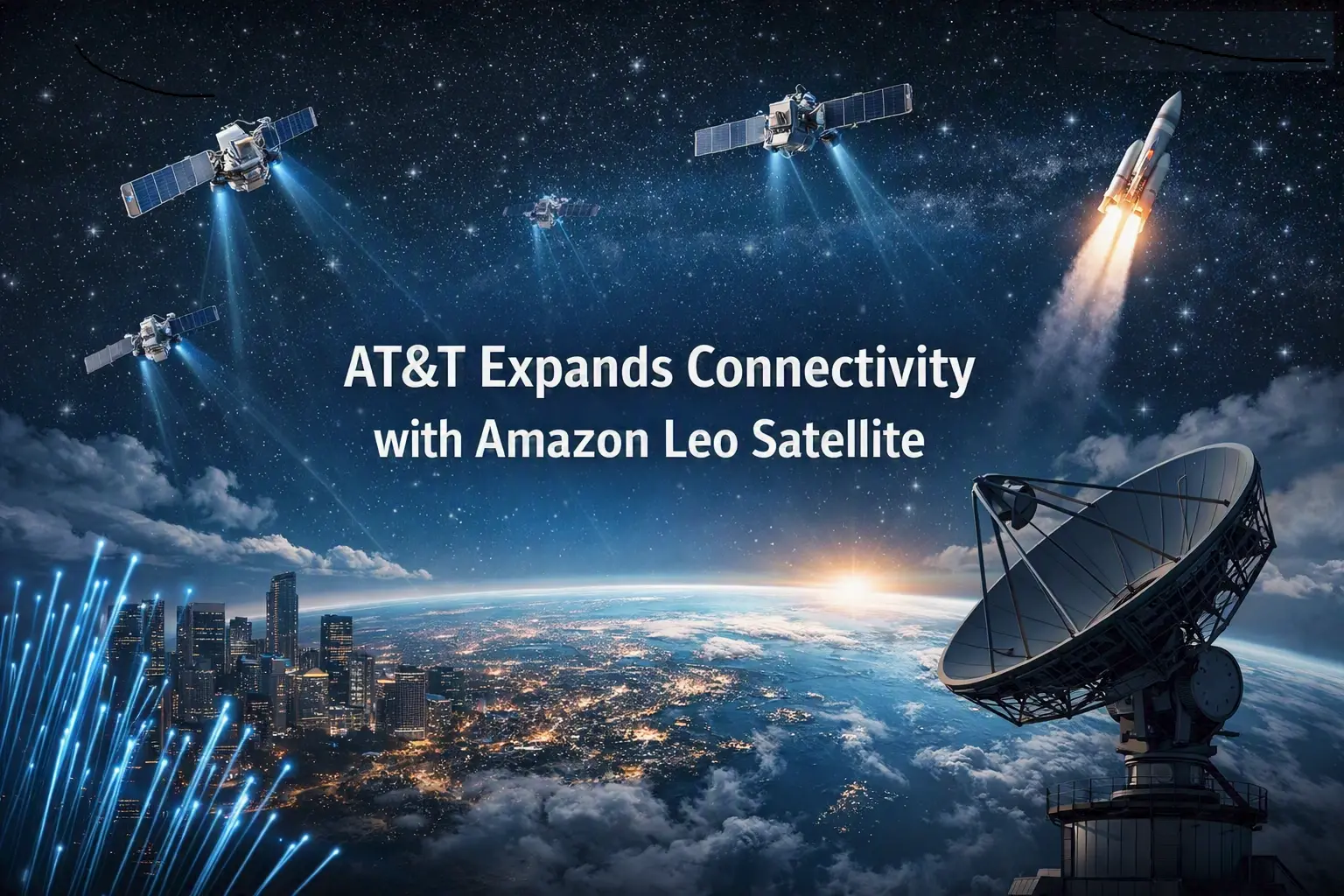
AT&T Business is strategically integrating Amazon Leo's Low Earth Orbit (LEO) satellite technology with its existing terrestrial fiber and 5G networks to create a "fiber-to-space" ecosystem. This collaboration, announced in February 2026 and further detailed in September 2026, aims to deliver resilient, high-speed, and low-latency connectivity to enterprise and public sector clients, particularly in remote and underserved areas, and to enhance network redundancy for critical operations like FirstNet.
Key Findings
* Hybrid "Fiber-to-Space" Architecture: AT&T is leveraging a tri-level network that combines its fiber and 5G infrastructure with Amazon Leo's LEO satellites and Amazon Web Services (AWS) cloud, enabling dynamic routing and seamless failover.
* Enhanced Geographic Reach and Resilience: The partnership is designed to eliminate domestic "dead zones" and provide robust network redundancy for business continuity and disaster response, ensuring critical connectivity even during terrestrial network failures.
* High Performance, Low Latency: Amazon Leo's enterprise-grade terminals have demonstrated download speeds exceeding 1.2 Gbps, with latency often under 50 milliseconds, significantly improving performance for real-time applications compared to traditional satellite options.
* Deep AWS Cloud Integration: The collaboration extends to migrating AT&T workloads to AWS hybrid cloud platforms and connecting AWS data centers via AT&T fiber, supporting advanced AI, edge computing, and secure data transfers.
* Targeted Enterprise and Public Sector Focus: Solutions are tailored for industries such as energy, logistics, utilities, defense, telehealth, and agribusiness, as well as reinforcing AT&T's FirstNet public safety network.
* Competitive Market Entry: While specific pricing and detailed Service Level Agreements (SLAs) for AT&T's Amazon Leo offering are pending announcement as of September 2026, the service is positioned to compete with other LEO and GEO providers through its performance, integration, and managed service approach.
Main Analysis
AT&T Business is embarking on a significant expansion of its connectivity architecture for enterprise and public sector clients through a strategic partnership with Amazon Leo. This collaboration, initially announced on February 4, 2026, with further operational details released on September 8, 2026, aims to build a resilient, high-performance network by integrating Amazon's Low Earth Orbit (LEO) satellite technology with AT&T's extensive terrestrial fiber and 5G infrastructure. The initiative focuses on delivering advanced connectivity solutions where traditional infrastructure faces limitations, enhancing overall network resilience, and enabling next-generation applications.
The "Fiber-to-Space" Ecosystem: Enhancing AT&T's Network Architecture
The core of this partnership is the creation of a "fiber-to-space" ecosystem, a sophisticated architecture designed to deliver resilient, high-speed, and low-latency connectivity. This framework directly enhances and interoperates with AT&T's existing networks, particularly benefiting enterprise and public sector clients.
Amazon Leo serves as a primary satellite layer for AT&T's business and public safety customers, working to eliminate domestic "dead zones" and address persistent coverage gaps where terrestrial fiber or 5G networks are challenging to deploy economically or logistically. This expansion allows AT&T to extend internet access without requiring extensive ground infrastructure buildouts over inhospitable terrain.
A critical aspect of this integration is the enhanced network resilience and redundancy it provides. The LEO satellite layer functions as an immediate "resilience layer" for AT&T's network, which is particularly crucial for its FirstNet public safety network. It helps ensure continuous connectivity for first responders during disasters or when terrestrial infrastructure fails. Amazon Leo's satellites offer seamless failover and backhaul redundancy during fiber disruptions, such as those caused by natural disasters, or in locations with volatile or no fixed infrastructure.
AT&T employs a "tri-level" network architecture, which combines its foundational fiber and 5G access layers with Amazon Leo's orbital capabilities and Amazon Web Services (AWS) cloud services. This setup supports flexible, software-defined routing, enabling traffic from 5G base stations to reroute across space-based relays to maintain service continuity in blackout zones or during outages. Routing policies can dynamically shift between terrestrial, wireless, and satellite transports based on bandwidth availability, cost, and latency thresholds.
Beyond basic internet access, the partnership involves a deep integration with AWS cloud services. This includes migrating major AT&T workloads to AWS hybrid cloud platforms and connecting AWS data centers via high-capacity AT&T fiber. This integrated ecosystem supports advanced AI applications at scale, edge computing, and secure transfers of large datasets for enterprise and government clients.
Addressing Connectivity Challenges in Remote and Underserved Areas
The expanded AT&T/Amazon Leo solution directly targets several connectivity challenges prevalent in remote and underserved areas for enterprise and public sector clients. By integrating LEO satellite technology with AT&T's terrestrial networks, the solution offers a multi-layered approach to provide resilient, high-speed, and low-latency broadband.
One of the primary challenges addressed is geographic limitations. Many remote, rural, and previously underserved areas lack reliable and high-speed internet because deploying fiber optic cables or traditional wireless infrastructure is either logistically difficult or economically unfeasible. The AT&T/Amazon Leo solution bypasses these constraints by providing satellite-based connectivity.
Network resilience and redundancy are significantly enhanced. The solution ensures critical operations can continue even when terrestrial networks are compromised by natural disasters, remote terrain, or other disruptions, creating a more robust, multi-layered experience. For instance, in an emergency, the satellite layer can provide crucial backhaul for FirstNet, AT&T's public safety platform.
Low latency for real-time applications is another major benefit. Traditional geostationary (GEO) satellites, orbiting at much higher altitudes, suffer from high latency (around 600 milliseconds or more), which severely impacts time-sensitive applications. LEO satellites, operating much closer to Earth at altitudes ranging from 590 km to 630 km, dramatically reduce latency to under 50 milliseconds in many cases, making real-time applications viable. Some projections indicate latency could be as low as 4 milliseconds. Amazon's testing in April 2024 achieved single-digit millisecond latencies.
The partnership also aligns with Amazon Leo's broader mission to bridge the digital divide by bringing broadband access to communities globally.
The combined AT&T/Amazon Leo solution offers several specific use cases and benefits for enterprise and public sector clients:
* Enhanced Business Continuity and Disaster Response: Organizations can maintain connectivity during outages, which is crucial for emergency services and critical infrastructure.
* Extended Geographic Reach for Operations: Enterprises can extend their networks to remote offices, field operations (e.g., oil fields, agribusiness), and mobile units, enabling hybrid cloud solutions and secure data transfers from nearly any location.
* Telecom Backhaul: Amazon Leo satellites can provide middle-mile connectivity, linking remote cell sites and wireless towers to AT&T's core network without costly ground infrastructure, supporting 4G/5G services in more locations.
* High-Bandwidth Applications: Support for data-intensive operations like video streaming, remote surveillance, and secure transfer of large datasets is enabled.
* Remote Operations and Monitoring: Facilitates remote support, assisted training, video conferencing, telemedicine in medically underserved regions, precision agriculture, and operational technology monitoring for industries like energy.
* Direct-to-Device (D2D) Connectivity: Amazon has filed an FCC application for a next-generation satellite constellation of 5,105 satellites for direct-to-device cellular connectivity, aiming to provide cellular signals to everyday cell phones in remote areas without traditional cell towers, with deployment beginning in 2028.
* Seamless Integration with AWS: The deep integration offers secure, private connectivity into the AWS cloud, providing a global communications infrastructure for data compute, storage, processing, and analytics.
Competitive Landscape: AT&T/Amazon Leo vs. Other Satellite Solutions
AT&T's enterprise satellite offering, leveraging Amazon Leo, enters a competitive market. While specific pricing and detailed Service Level Agreements (SLAs) for AT&T's managed service are not yet publicly available (as of September 2026), its projected performance and strategic positioning allow for comparison against other LEO and Geostationary Earth Orbit (GEO) satellite solutions.
Amazon Leo's enterprise-grade terminals have demonstrated peak downlink speeds exceeding 1.2 gigabits per second (Gbps), specifically 1,280 Mbps to 1,289 Mbps, in tests conducted in September 2025. Uplink speeds reached up to 400 Mbps. Initial beta service for standard enterprise terminals is offering download speeds up to 400 Mbps, with specialized high-demand units reportedly achieving speeds exceeding 1 Gbps. Latency is expected to rival traditional fiber optics, falling between 20 and 40 milliseconds due to the LEO constellation's lower altitude (590 to 630 kilometers). Amazon anticipates competitive pricing, potentially bundling with Amazon Prime memberships and AWS cloud services. A key differentiator for AT&T's offering is the deep integration with AWS and its leveraging of AT&T's extensive customer base, including FirstNet.
Competing LEO Satellite Solutions:
1. Starlink Business (SpaceX): Offers download speeds from 135–310 Mbps and upload speeds of 10–50 Mbps, with latency typically between 20–40 milliseconds. The "High Performance" dish supports over 400 Mbps downloads. Hardware costs range from $1,999 to $2,500. Monthly service for Local Priority plans (as of August 2026) ranges from $55 for 50GB to $530 for 2TB. Global Priority plans range from $250 for 50GB to $1,150 for 1TB. Starlink's Priority plans include a 99.9% network availability SLA, offering a credit of 20% of the base monthly service cost for violations, but generally do not offer a Committed Information Rate (CIR).
2. OneWeb (Eutelsat OneWeb LEO): Primarily targets B2B clients. Tested download speeds of 400 Mbps, with latency between 30-70 ms. Hardware was estimated at $10,000 for enterprise in 2023, while a Flat High Performance terminal is approximately $1,500. Monthly service industry estimates from 2023 placed enterprise plans between $1,000–$1,500/month. Reseller data from May 2026 shows maritime plans from $5,595/month for 1,200 GB up to $29,500/month for unlimited ocean access. Limited data plans through resellers show options like 100GB at $300/month, with overage charges of $30 per 10GB. OneWeb's key differentiator is its provision of contractual SLAs and CIR, ensuring guaranteed availability, speed, and latency, along with AES-256 encryption, static IPs, and MPLS support. Contracts typically require a minimum 12-month commitment.
Conclusion
AT&T Business's integration of Amazon Leo satellite technology marks a strategic evolution in its connectivity offerings for enterprise and public sector clients. By forging a "fiber-to-space" ecosystem, AT&T aims to deliver a resilient, high-speed, and low-latency network that extends coverage to remote areas and ensures business continuity. This partnership, deeply integrating with AWS, positions AT&T to address critical connectivity challenges and compete in the evolving satellite broadband market.
📚Read More Articles About AT&T

How Does AT&T Install Fiber Optics in Your Home?
August 10, 2026
How Much Does It Cost to Install AT&T Internet?
July 27, 2026
AT&T Deals for New Customers: Your Ultimate Guide to Savings in 2026
May 4, 2026