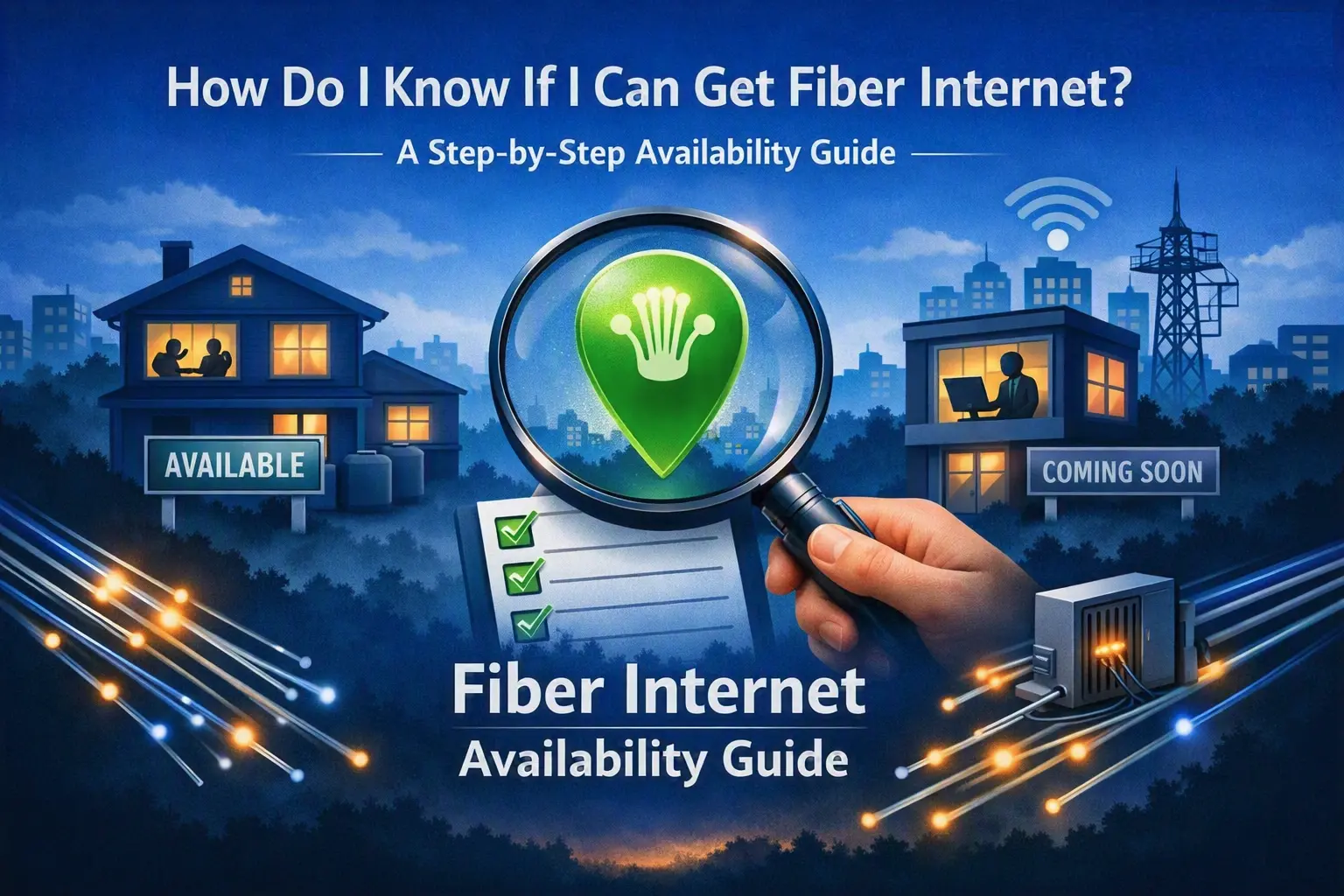
How Do I Know If I Can Get Fiber Internet? A Step-by-Step Availability Guide
Fiber internet has a reputation problem, and it isn't really fiber's fault. The technology itself — symmetrical speeds, low latency, high reliability — is well understood. What trips people up is figuring out whether it's actually reachable at their specific address. Coverage maps are often vague, provider websites give inconsistent answers, and "coming soon" can mean six months or six years depending on who you ask. This guide walks through exactly how fiber availability is determined, where to check it reliably, and what your realistic options are if fiber hasn't reached your street yet.
Quick Answer
The most reliable way to find out if you can get fiber internet is to enter your exact street address — not just your ZIP code — into either the FCC's National Broadband Map or a specific provider's availability checker. The FCC's Fixed Broadband Map shows which providers report offering service at a given home or business, along with the technology type and maximum advertised speeds for that exact location. Because fiber networks aren't activated all at once across a neighborhood</cite>, always check at the address level rather than relying on a general coverage map, since a provider's coverage area can end halfway down a street or even affect one side of a block differently than the other.
Key Findings
52% of U.S. households had fiber availability as of 2026, up from 46% in 2025 — a 13% year-over-year increase</cite>.
Fiber availability splits unevenly between urban and rural areas: about 50% of urban locations have fiber access compared to roughly 40% of rural locations.
Approximately 94% of U.S. homes and businesses have access to at least one broadband provider of some kind, according to the FCC's Internet Access Services Report, though that figure includes cable, DSL, fixed wireless, and satellite — not just fiber.
Fiber coverage has grown to roughly 60% of served locations nationally, reflecting years of capital-intensive network buildout by major providers.
Fiber providers had passed roughly 84.6 million U.S. homes by the end of 2025, a major driver in closing the gap between urban and rural broadband performance.
Fiber coverage varies dramatically by state — Rhode Island leads the nation at 81% availability, while Alaska trails at just 13%.
The federal Broadband Equity, Access, and Deployment (BEAD) program, a $42.45 billion initiative funded through the Infrastructure Investment and Jobs Act, is now moving into its construction phase, with all states and territories having submitted final proposals.
How Fiber Availability Actually Works
Fiber Is Rolled Out Address by Address, Not City by City
Fiber isn't available everywhere at once — providers build these networks city by city, and often block by block. This is different from how most people think about cable or wireless coverage, which tends to blanket a broader service area more evenly. Fiber requires physically running new cable to a location, so a neighborhood can be "served" on paper while individual streets, or even individual homes on a street, are still waiting for a connection.
This is why coverage maps show approximate service areas, but fiber availability ultimately has to be confirmed at the address level. A map showing your ZIP code as "fiber available" is a starting point, not a guarantee.
Why "Coming Soon" Is So Hard to Pin Down
Because fiber networks aren't activated all at once, "coming soon" status on a provider's website can mean almost anything — it might indicate active construction a few months out, or a neighborhood still years away from being prioritized. If your address shows as "coming soon" rather than "available," it's worth checking back periodically and, where possible, asking the provider directly what phase of construction your street is actually in.
Two Authoritative Ways to Check
1. The FCC National Broadband Map. This tool shows the fiber, cable, DSL, satellite, or fixed wireless services reported as available at each home or small business, including which providers report service at that exact location and the maximum advertised speeds they offer. It's built from data providers are required to submit, so it's the most comprehensive single source — though it isn't perfect. In some rural areas or new developments, a provider might actively serve a few households at one end of a block but lack the physical lines to reach a specific address, even if the surrounding area is flagged as served. If you believe the map is incorrect or incomplete for your address, you can submit a challenge directly to the FCC.
2. Provider-specific address lookup tools. Major fiber providers — including AT&T Fiber, Frontier Fiber, Spectrum Fiber, Optimum Fiber, and Kinetic Fiber— maintain their own availability checkers that tend to reflect real-time construction status more precisely than aggregated map data. AT&T's tool, for example, lets you enter your home or business address to see exactly which services — including AT&T Fiber or AT&T Internet Air — are available, and lets you sign up to be notified when service expands into your area. The general pattern across providers: enter your full street address exactly as formatted, and include apartment or unit numbers for multi-dwelling buildings, since availability can differ unit by unit in larger buildings.
What Counts as "Fiber" in Official Data
For broadband to count as meeting the FCC's definition of advanced telecommunications capability, it needs to deliver at least 100 Mbps download and 20 Mbps upload. When researchers report fiber availability statistics, they're generally filtering for residential locations where fiber service meets or exceeds that threshold — not just any fiber-adjacent infrastructure in the area.
Research Insights
The gap between "broadband available" and "fiber available" is one of the more consistently misunderstood parts of shopping for internet service. Roughly 94% of U.S. addresses have access to some form of broadband, but fiber specifically covers closer to 60% of served locations — meaning a meaningful share of "broadband-covered" homes are actually relying on cable, DSL, or fixed wireless rather than fiber. Shoppers who see "broadband available" messaging and assume that means fiber is often disappointed once they check address-level detail.
There's also a competitive dynamic worth understanding: fiber buildout tends to accelerate in areas where a provider faces existing cable competition, since fiber's symmetrical speeds and lower latency are a differentiator providers use to win customers away from incumbent cable networks.
Cable providers have responded by accelerating their own upgrades — including DOCSIS 4.0 and high-split DOCSIS deployments — specifically to remain competitive as fiber expands</cite>. In practice, this means that even households who can't get fiber today may see meaningfully faster cable speeds arrive in their area as a secondary effect of fiber competition nearby.
Geography continues to be the dominant factor behind the urban-rural fiber gap. States with large landmasses, low population density, and difficult terrain such as mountains or permafrost consistently rank lowest for broadband performance, while smaller, densely populated states with mature broadband markets consistently rank at the top. That said, 43 states managed to reduce the gap between urban and rural broadband performance during the second half of 2025 alone, suggesting the geographic disadvantage is narrowing, even if slowly.
Consumer Impact
For most people, the practical impact of this patchwork rollout is uncertainty rather than total unavailability. A household might see fiber advertised heavily in local marketing, check their address, and find it's not actually available yet — which can feel like a bait-and-switch even though it usually reflects an honest gap between marketed footprint and completed construction. Renters and residents of multi-unit buildings face an added wrinkle: including apartment or unit numbers is essential, since a building can have fiber service available to some units and not others depending on internal wiring.
Households in rural or low-density areas face the steepest climb. With rural fiber availability sitting around 40% compared to 50% in urban areas, and with construction costs per household significantly higher in low-density regions, fiber access in rural America is likely to keep lagging urban and suburban markets for the foreseeable future, even as federal funding programs work to close that gap.
Future Outlook
The BEAD program's $42.45 billion in funding is now moving into its construction phase, with all 56 states and territories having submitted final proposals and the first BEAD-funded projects expected to break ground</cite>. This federal push, combined with continued private investment from major carriers, should meaningfully expand fiber's footprint over the next several years — particularly in currently underserved and rural areas that haven't been commercially attractive for providers to build out on their own.
Fixed wireless access (FWA) and low-Earth orbit satellite broadband are also reshaping the competitive picture, giving households in areas without near-term fiber plans a meaningful alternative that didn't exist a few years ago. For many rural households, the realistic path to significantly faster internet over the next year or two may run through FWA or satellite rather than fiber specifically — even as fiber construction continues to expand elsewhere.
Frequently Asked Questions
How do I check if fiber internet is available at my exact address?
Enter your full street address, including apartment or unit number if applicable, into either the FCC National Broadband Map or a specific provider's availability checker. Address-level results are far more reliable than general coverage maps, since fiber availability can vary block by block or even unit by unit.
What does "coming soon" mean on a fiber provider's website?
"Coming soon" status can mean almost anything, from active construction happening in the next few months to a neighborhood still years away from being prioritized. It's worth checking back periodically and, when possible, contacting the provider directly for a more specific construction timeline.
What percentage of U.S. homes actually have fiber available?
As of 2026, about 52% of U.S. households have fiber availability, up from 46% the previous year. Fiber specifically covers roughly 60% of "served" broadband locations nationally, while a broader 94% of homes have access to some form of broadband.
Why does the coverage map say fiber is available, but the provider says it isn't at my address?
Coverage maps are often generated at a broader block or neighborhood level, which can miss situations where a provider serves part of a block but lacks the physical lines to reach a specific address due to terrain, driveway length, or property barriers. Always confirm with a direct address-level lookup rather than relying on the visual map alone.
What should I do if fiber isn't available at my address yet?
Consider joining a provider waitlist or demand survey, since expressed interest can influence expansion priorities; check whether fixed wireless or 5G home internet is available as a faster alternative to DSL or satellite; and in the meantime, upgrade to the fastest cable or hybrid fiber-coaxial plan available, since these can still offer solid performance while you wait.
Can I do anything to encourage a fiber provider to build in my neighborhood?
Registering for availability notifications with providers, and contacting local officials such as county commissioners or city council members, can help, since many municipalities are actively directing state and federal broadband funding toward underserved areas.
Is the FCC's National Broadband Map ever wrong?
Yes — if you believe the map is incorrect or incomplete for your address, you can submit a challenge directly to the FCC to have it corrected. This process exists specifically because provider-submitted data doesn't always reflect on-the-ground reality perfectly.
Conclusion
Figuring out whether fiber reaches your home doesn't have to be a guessing game — it just requires checking in the right place, at the address level, rather than relying on a general sense of what's available in your city or ZIP code. Start with the FCC's National Broadband Map for a comprehensive first look, then confirm directly with any provider whose footprint includes your area. If fiber isn't there yet, cable and hybrid fiber-coaxial plans remain a solid stopgap, and fixed wireless or satellite are increasingly credible options for rural households. With federal BEAD funding now moving into construction, fiber's footprint is likely to keep expanding over the next several years, even in areas that have historically been overlooked.
Readers who want a deeper breakdown of provider-by-provider availability and speed comparisons can find additional research on CablePapa. For a personalized check of what's actually available at your address, calling (855) 210-8090 connects you with someone who can walk through your specific options.
📚Read More Articles About Internet Providers

How to Get Cheap Internet in Texas That's Actually Reliable
September 7, 2026
Verizon Fios vs. AT&T Fiber: Which Fiber Internet Is Better in 2026?
August 3, 2026
Best Internet Providers for Apartments in 2026
July 20, 2026