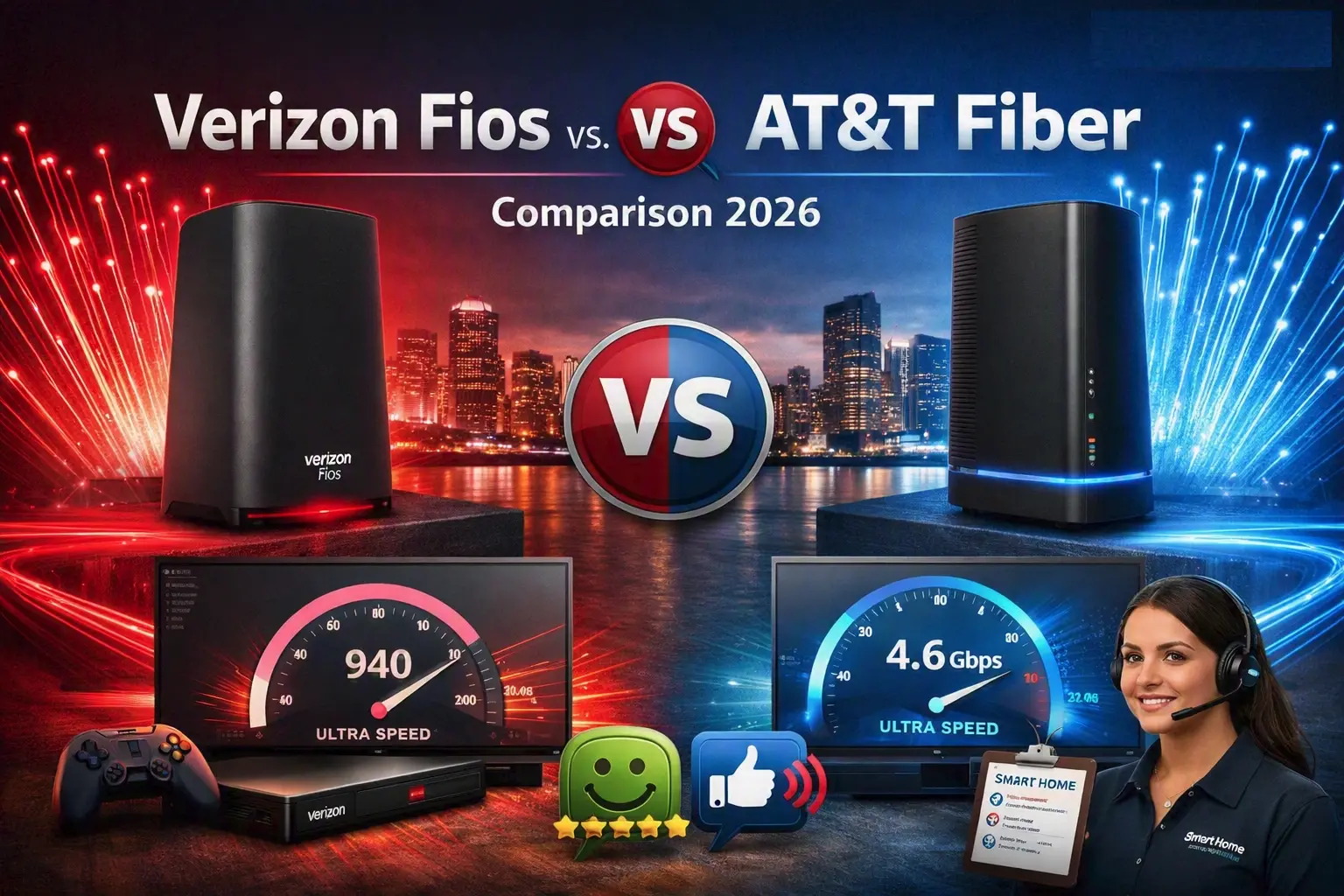
Verizon Fios and AT&T Fiber are two of the most established 100% fiber-optic internet providers in the United States, and both are frequently cited as top performers in independent customer satisfaction research. Choosing between them isn't as simple as picking the faster headline speed — the better answer depends on address-level availability, household usage, and which factor matters most: raw top-end speed, price-per-tier value, or long-term customer satisfaction. This report compares both providers using industry benchmark data rather than promotional claims, so readers can weigh the tradeoffs before checking availability at their own address.
Quick Answer
Both Verizon Fios and AT&T Fiber are 100% fiber-optic networks offering symmetrical upload and download speeds. AT&T Fiber currently offers the higher maximum speed tier, up to 5 Gbps in select areas, compared with Verizon Fios's top tier around 2 to 2.3 Gbps. Verizon Fios has generally offered a lower entry-level price, while AT&T has held the top spot in the American Customer Satisfaction Index's (ACSI) fiber ISP category for multiple consecutive years.
Neither provider has a nationwide fiber footprint, so for most households the deciding factor will be which provider actually serves the address in question. In short: AT&T Fiber tends to win on top speed and long-run customer satisfaction rankings, while Verizon Fios tends to win on entry-tier pricing where both are available.
Key Findings
Maximum speed: AT&T Fiber's fastest published residential tier reaches up to 5 Gbps, while Verizon Fios tops out around 2 to 2.3 Gbps in most markets.
Customer satisfaction (ACSI): AT&T Fiber has led the ACSI fiber ISP category for multiple consecutive years, scoring in the high-70s to 80 range on ACSI's 100-point scale, with Verizon Fios and Google Fiber typically landing a few points behind in the mid-to-high 70s.
Entry-level pricing: Verizon Fios has generally started at a lower monthly price than AT&T Fiber's comparable entry tier, though AT&T has narrowed or reversed that gap on some mid-tier plans depending on the market and promotion.
Network technology: Both providers use 100% fiber-optic lines to the home, meaning both deliver symmetrical upload and download speeds and low latency — a meaningful advantage over cable or fixed wireless for gaming and video conferencing.
Availability footprint: Neither provider covers the whole country. AT&T Fiber's premium tier reaches roughly a quarter of AT&T's overall coverage area, while Verizon's top Fios tier reaches under a fifth of Verizon's footprint, meaning the fastest plans from either company are only available in a subset of each provider's total service area.
Contract terms: Both providers generally offer no-annual-contract fiber plans today, a shift from years past when term contracts were more common in the industry.
Summary Table: Verizon Fios vs. AT&T Fiber
Factor | Verizon Fios | AT&T Fiber |
|---|---|---|
Network type | 100% fiber-optic | 100% fiber-optic |
Top speed tier | ~2–2.3 Gbps | Up to 5 Gbps (select areas) |
Typical entry price | ~$35–$50/mo | ~$55–$80/mo |
Data caps | None | None |
Annual contract | Generally none | Generally none |
ACSI fiber satisfaction score (recent) | Mid-to-high 70s | High 70s to 80 (category leader) |
Coverage footprint | Northeast-concentrated, expanding via Frontier acquisition | Broader multi-region footprint, expanding via Lumen acquisition |
Equipment | Router included; extenders ~$10/mo each | Equipment included |
Speed: AT&T Leads on the Top End
Both companies deliver symmetrical fiber speeds, but AT&T currently publishes a higher ceiling. AT&T's top residential fiber tier is marketed at up to 5 Gbps in areas with the newest infrastructure, while Verizon Fios's highest widely available tier sits at roughly 2 Gbps, with select markets reaching slightly higher.
For the average household — streaming, video calls, remote work, a handful of connected devices — even the entry-level 300 Mbps tier from either provider is more than sufficient. The gap matters primarily for power users: households with many simultaneous 4K streams, large file transfers, or dedicated home server/NAS setups will notice the difference between a 1 Gbps plan and a multi-gig plan more than a typical family will.
Price: Verizon Often Wins at Entry Level
Pricing is where Verizon Fios has typically held an edge, particularly at the entry tier, where its base fiber plan has often launched a few dollars cheaper per month than AT&T's comparable tier. AT&T has narrowed this in some markets at the mid-tier (500 Mbps–1 Gbps) level and can be competitive when bundled with an AT&T wireless line, which sometimes unlocks a discount on Fiber service. As with any ISP comparison, advertised starting prices can change by market and promotion, so confirming current pricing at a specific address is the only reliable way to compare real costs.
Customer Satisfaction: AT&T Has the Longer Track Record
Independent, large-sample research from the American Customer Satisfaction Index has ranked AT&T Fiber as the top-rated fiber ISP nationally for multiple consecutive years, generally scoring several points ahead of Verizon Fios and Google Fiber, which have frequently tied for second place. Verizon Fios, however, remains solidly in the upper tier of ISP satisfaction overall — well above cable providers — and has posted year-over-year score improvements in recent survey cycles.
Both companies' fiber satisfaction scores are meaningfully higher than the broader non-fiber ISP category average, reinforcing that the technology itself (symmetrical fiber vs. cable or DSL) is a bigger driver of customer happiness than the specific fiber brand chosen.
Availability: The Deciding Factor for Most Households
Neither provider is available everywhere, and this is often the real deciding factor rather than any speed or price comparison. Verizon Fios has historically concentrated its fiber footprint in the Northeast and Mid-Atlantic, though its pending acquisition of Frontier is expected to expand that footprint significantly.
AT&T Fiber has a broader multi-region presence today and is actively expanding, including through infrastructure acquisitions aimed at reaching millions of additional fiber locations. Because coverage varies block by block in some cities, the only reliable way to know which provider — if either — serves a specific address is to check availability directly.
Research Insights
The most useful pattern in this comparison is that the "better" fiber provider is largely determined by geography, not by an inherent quality gap between the two networks. Because both use the same underlying technology (fiber-to-the-home with symmetrical speeds), the meaningful differences show up in three places: top-tier speed ceiling, customer service track record, and price at the entry tier.
AT&T's advantage in the ACSI rankings has been persistent enough — multiple consecutive years at the top of the fiber category — that it appears to reflect a durable operational strength (installation experience, network reliability, or billing simplicity) rather than a single good year. Verizon's consistent price advantage at the entry tier suggests the company is positioning Fios as the value fiber option in the markets where it competes, rather than trying to win on the technical speed ceiling.
For consumers, this means the decision framework should be: first, confirm which provider (if either) is actually available at the address; second, decide whether the household's usage pattern justifies paying for a multi-gig tier or whether a mid-tier plan covers actual needs; and third, weigh the ACSI satisfaction gap against any local pricing or bundling advantage. A multi-gig AT&T plan is of no practical value to a household that would be equally well served — and better served financially — by a 500 Mbps or 1 Gbps plan from either provider.
Consumer Impact
For households where both providers are available, the practical impact of these findings is that Verizon Fios is the stronger choice for budget-conscious households whose needs are met by speeds up to roughly 1 Gbps, while AT&T Fiber is the stronger choice for households that want the highest available speed ceiling or that weigh long-term customer satisfaction data heavily. Households in areas where only one provider is available should treat the comparison as informational rather than decisional, since fiber from either company will outperform cable or DSL alternatives on latency and upload speed regardless of brand.
Future Outlook
Both companies are expanding aggressively. Verizon's pending acquisition of Frontier is expected to extend the Fios brand and fiber infrastructure well beyond its traditional Northeast base, while AT&T continues to add fiber locations organically and through its planned acquisition of Lumen's mass-market fiber business. As both footprints grow, more households will have a genuine head-to-head choice between the two providers rather than a single-option market, which should keep pricing competitive and put continued pressure on both companies to maintain their ACSI standing.
Frequently Asked Questions
Is AT&T Fiber faster than Verizon Fios?
At the top end, yes. AT&T's fastest residential tier reaches up to 5 Gbps in select areas, while Verizon Fios currently tops out around 2 to 2.3 Gbps. For most everyday households, both providers' lower tiers (300 Mbps–1 Gbps) are more than sufficient.
Is Verizon Fios cheaper than AT&T Fiber?
Verizon Fios has generally offered a lower entry-level price than AT&T Fiber's comparable tier, though pricing varies by market and promotion. AT&T can be competitive at mid-tier speeds, especially when bundled with AT&T wireless service.
Which has better customer satisfaction, AT&T Fiber or Verizon Fios?
According to the American Customer Satisfaction Index, AT&T Fiber has ranked as the top fiber ISP nationally for multiple consecutive years, typically scoring a few points higher than Verizon Fios, which usually lands in a tie for second place with Google Fiber.
Do Verizon Fios and AT&T Fiber have data caps?
No. Both providers advertise fiber plans with no data caps.
Do I need an annual contract for Verizon Fios or AT&T Fiber?
Generally no. Both providers currently offer no-annual-contract fiber plans, though it's worth confirming current terms at signup since promotions can vary.
Which provider has better coverage, AT&T or Verizon Fios?
AT&T Fiber currently has a broader multi-region footprint. Verizon Fios has historically been concentrated in the Northeast and Mid-Atlantic, though its planned acquisition of Frontier is expected to expand its fiber coverage significantly.
Is fiber internet better than cable for gaming and video calls?
Yes, generally. Because fiber offers symmetrical upload and download speeds and lower latency than cable, both AT&T Fiber and Verizon Fios typically outperform cable providers for online gaming, video conferencing, and large uploads.
Conclusion
Verizon Fios and AT&T Fiber are both strong, well-reviewed 100% fiber-optic providers, and the "better" option depends more on what a household values than on any clear overall winner. AT&T Fiber currently leads on top-end speed and has the longer track record atop the ACSI fiber satisfaction rankings, while Verizon Fios has typically offered the lower entry-level price for households whose needs are met by mid-tier speeds. Because coverage for both providers is address-specific, the most reliable next step is checking which one — or both — actually serves your home before comparing final pricing. Readers can research current fiber availability and provider details on CablePapa, or call (855) 210-8090 to confirm plans and pricing in their area.
Resource
Verizon Fios vs. AT&T Fiber: Which Fiber Internet Is Better in 2026?