500 Mbps vs 1 Gig Internet: Which Plan Should You Choose?
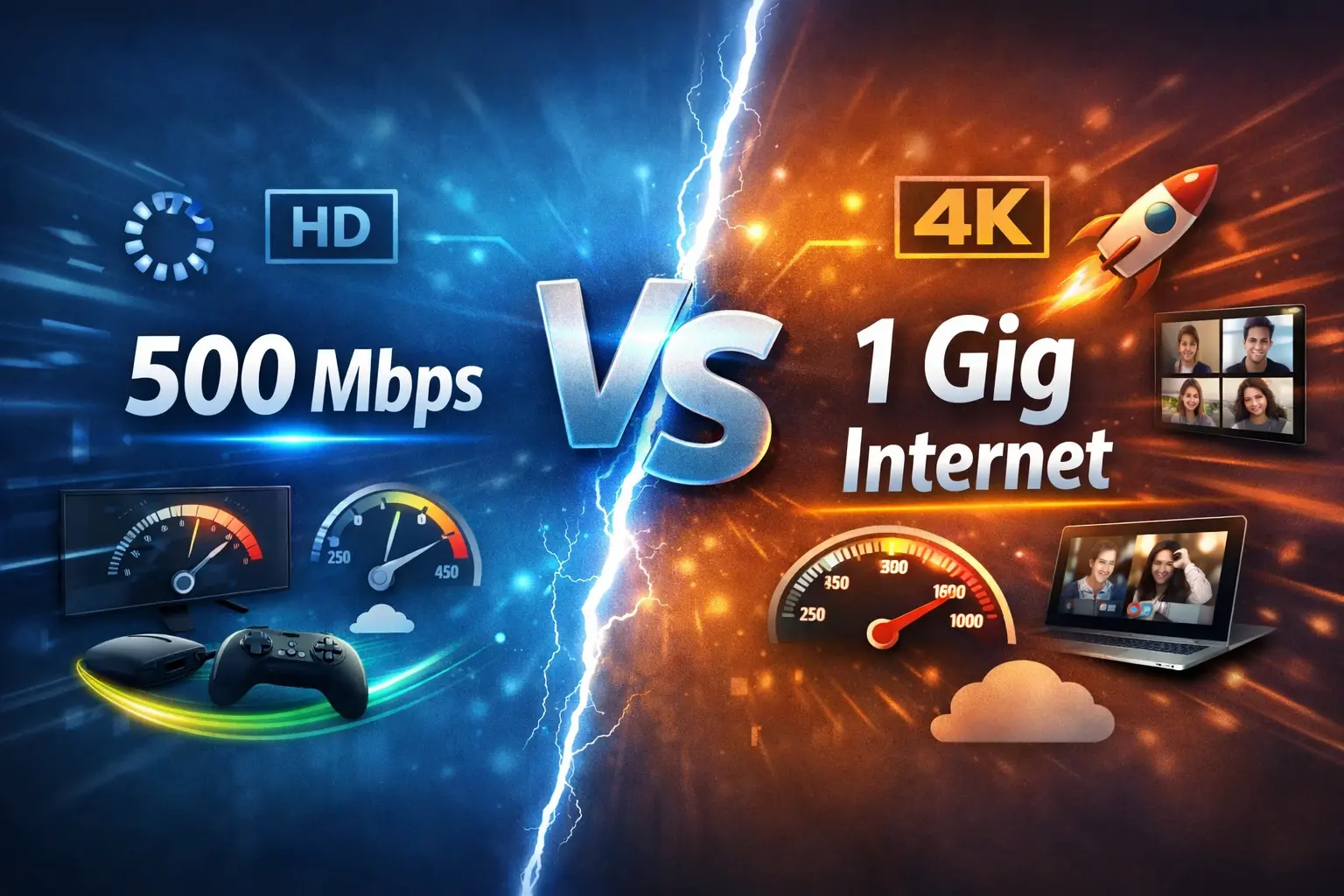
When you're shopping for a new internet plan, two tiers come up more often than any other: 500 Mbps and 1 Gig (1,000 Mbps). They sit at the heart of what most major providers offer for residential customers, and the choice between them carries a real monthly cost difference that adds up quickly over a one- or two-year contract.
The question isn't simply "which is faster?" — obviously, 1 Gig is faster. The real question is: which plan actually matches what your household needs, and which is the smarter investment for the price?
That answer depends on household size, how many people are online simultaneously, what they're doing, whether upload speed matters for your use case, and how much headroom you want for the years ahead. It also depends on whether you're buying cable or fiber — a distinction that changes the 500 Mbps vs. 1 Gig calculation entirely.
This guide cuts through the noise with real-world performance data, household-by-household analysis, side-by-side pricing from major providers, and a clear decision framework so you can choose with confidence.
For personalized plan recommendations by ZIP code, explore CablePapa.com or call (855) 210-8090 to speak with a broadband specialist who can review what's currently available at your address.
Quick Answer: 500 Mbps vs. 1 Gig Internet
Factor | 500 Mbps | 1 Gig (1,000 Mbps) |
|---|---|---|
Best for | Households of 2–5 users, moderate device counts | Households of 4+ users, heavy device loads, power users |
Simultaneous 4K streams | Up to 20–25 streams (theoretical) | Up to 40–50 streams (theoretical) |
Typical price range | $40–$65/month | $60–$80/month |
Upload speed (cable) | ~20–35 Mbps | ~35–50 Mbps |
Upload speed (fiber) | ~500 Mbps (symmetrical) | ~1,000 Mbps (symmetrical) |
Future-proofing | Good for 2–3 years | Strong for 4–5+ years |
Recommended for gamers | Yes — excellent | Yes — marginal upgrade |
Recommended for remote workers | Yes — 1–2 workers | Yes — 2+ workers simultaneously |
FCC future-ready benchmark | Exceeds minimum | Meets long-term goal |
Bottom line: For most households of 2–4 people with typical usage patterns, 500 Mbps is entirely sufficient today. The upgrade to 1 Gig makes the most sense for larger households, multi-worker homes on fiber, smart home power users, or anyone who wants 4–5 years of comfortable headroom without revisiting the upgrade question.
Key Findings
OpenVault Q4 2024 data shows the average U.S. broadband household consumed 698.2 GB per month — an all-time high, up 8.9% year-over-year. Households on 1 Gbps plans consumed 955 GB in Q2 2025, demonstrating that higher speed tiers drive significantly higher usage.
Broadband consumption is accelerating. Q2 2025 year-over-year growth of 13.4% — the fastest in four years — indicates that plans that feel comfortable today may feel constrained within 2–3 years.
The FCC's long-term benchmark is 1 Gbps download / 500 Mbps upload, its stated target for future-ready broadband infrastructure. 500 Mbps exceeds the current 100/20 Mbps minimum, but falls short of where the agency projects household demand is heading.
The price gap between 500 Mbps and 1 Gig has narrowed considerably. Across major providers, the typical premium for upgrading from 500 Mbps to 1 Gig is now $15–$25/month — often less than the price of a single streaming service.
Upload speed is the critical differentiator on cable plans. Cable 500 Mbps and 1 Gig plans offer similar upload speeds (20–50 Mbps), making the upgrade less impactful for upload-heavy households on cable. Fiber plans offer symmetrical speeds at both tiers — where the upgrade jumps from 500 to 1,000 Mbps upload.
Actual delivered speeds average 80–95% of advertised on wired Ethernet, per SpeedTestHQ's 2026 ISP price comparison analysis — meaning a 500 Mbps plan may deliver 400–475 Mbps under typical conditions.
Understanding the Difference: What 500 Mbps and 1 Gig Actually Mean
Before comparing the two plans head-to-head, it helps to anchor the numbers in practical terms.
500 Mbps delivers half a gigabit per second of download bandwidth. That is a level of throughput that would have been considered extraordinary for a residential connection just five years ago. Today, it sits comfortably in the mid-tier of what major providers offer — fast enough to handle everything most American households do online, including simultaneous 4K streaming, HD video conferencing, online gaming, and a full suite of smart home devices.
1 Gig (1,000 Mbps) delivers the full gigabit. It represents twice the bandwidth of 500 Mbps on paper — though in practice, the day-to-day difference for many households is less dramatic than that ratio implies, because most common activities don't come close to exhausting 500 Mbps to begin with.
What matters more than the headline number is how the bandwidth is distributed across your household's simultaneous demands — and whether the specific use cases in your home push you toward the higher tier.
One more thing to understand upfront: the gap between 500 Mbps and 1 Gig behaves very differently depending on whether you're buying cable or fiber. On fiber, the upgrade doubles both download and upload speeds. On cable, the upload speed barely changes — a detail that matters enormously for certain households.
500 Mbps vs. 1 Gig: Side-by-Side Performance
Streaming Video
A single 4K stream consumes approximately 15–25 Mbps. Netflix's own technical guidelines put 4K HDR at about 25 Mbps per stream. On that basis:
500 Mbps can theoretically support 20–33 simultaneous 4K streams before bandwidth is fully consumed.
1 Gig theoretically supports 40–66 simultaneous 4K streams.
In the real world, no household is running 20 simultaneous 4K streams. The practical streaming comparison comes down to whether your household routinely runs 5–10 high-quality streams at once — which only the largest families reach. For households running 3–6 streams simultaneously, both plans perform identically.
Verdict: No meaningful real-world difference for streaming in households of up to 8–10 people.
Online Gaming
Online gaming is one area where the 500 Mbps vs. 1 Gig comparison reveals something counterintuitive: bandwidth tier matters very little; connection quality matters enormously.
Most online games require only 3–25 Mbps of download bandwidth. Call of Duty, Fortnite, Apex Legends, and similar titles are not bandwidth-intensive in the way 4K streaming is. What they are sensitive to is latency (ping) and jitter — the consistency and responsiveness of the connection.
Both 500 Mbps and 1 Gig plans from the same provider on the same technology (fiber or cable) will deliver essentially identical gaming latency. The speed tier itself does not reduce ping. What reduces ping is the network technology (fiber typically delivers lower and more consistent latency than cable), the quality of the provider's routing infrastructure, and the distance from the gaming server.
Where the 1 Gig plan does help gaming households is with large game downloads. A 120 GB game download that takes approximately 30 minutes on a 500 Mbps plan completes in about 15 minutes on a 1 Gig plan — a tangible convenience advantage for players who frequently download new titles or major updates.
Verdict: For gameplay quality, no difference. For large downloads, 1 Gig is meaningfully faster.
Remote Work and Video Conferencing
This is where the analysis gets more nuanced — and where the cable vs. fiber distinction becomes critical.
Download speed is rarely the constraint for remote workers. Video conferencing requires only 3–5 Mbps per participant for HD quality. Most cloud-based tools, VPN connections, and web-based applications consume well under 50 Mbps even under active use.
Upload speed is the actual bottleneck for work-from-home households. Uploading large files to cloud storage, sharing screens during video calls, hosting virtual meetings, and sending large datasets all depend on upstream bandwidth.
Here is where the cable vs. fiber split matters:
Plan | Cable Upload Speed | Fiber Upload Speed |
|---|---|---|
500 Mbps | ~20–35 Mbps | ~500 Mbps |
1 Gig | ~35–50 Mbps | ~1,000 Mbps |
On cable internet, moving from 500 Mbps to 1 Gig buys you only a marginal upload improvement — from roughly 20–35 Mbps to 35–50 Mbps. For households with one remote worker, either plan is workable. For households with two simultaneous remote workers, both on active video calls and uploading files, the cable 1 Gig upload ceiling can still feel constrained.
On fiber internet, the difference is transformative. A fiber 500 Mbps plan delivers 500 Mbps symmetric upload — already more than adequate for virtually any work-from-home scenario. A fiber 1 Gig plan delivers 1,000 Mbps symmetric upload — accommodating even the most upload-intensive professional workflows with ease.
Verdict for cable users: The upload improvement from 500 Mbps to 1 Gig is modest. Fiber is the more impactful choice if upload speed is a priority. Verdict for fiber users: Both tiers work well for most remote workers; 1 Gig provides meaningful headroom for households with 2+ simultaneous heavy users.
Smart Home and IoT Devices
Smart home devices — thermostats, voice assistants, security cameras, smart locks, automated lighting — each consume minimal individual bandwidth. However, in aggregate, a fully connected home can accumulate 20–80+ Mbps of baseline IoT consumption, particularly if multiple 4K security cameras are streaming continuously.
Neither 500 Mbps nor 1 Gig will strain under typical smart home demands. Even a home with 30 IoT devices running simultaneously is unlikely to consume more than 100 Mbps of combined bandwidth from those devices alone.
The more relevant bottleneck for smart home networks is router capacity — how many simultaneous connections the router can manage efficiently — and Wi-Fi coverage quality, not plan bandwidth.
Verdict: No practical difference between 500 Mbps and 1 Gig for smart home performance. Router and Wi-Fi quality matter more.
Large File Downloads and Transfers
For households that regularly work with large files — video editors uploading project files, developers syncing large repositories, backup systems transferring terabytes of data — the 500 Mbps vs. 1 Gig distinction is most directly felt.
A 100 GB file transfer:
At 500 Mbps (real-world ~450 Mbps): approximately 29 minutes
At 1 Gig (real-world ~900 Mbps): approximately 15 minutes
For routine tasks, this difference is convenient but not critical. For professionals who transfer large volumes of data daily as part of their work, it represents genuine time savings that compound across a workweek.
Verdict: 1 Gig delivers a meaningful advantage for high-volume file transfer workflows. For occasional large transfers, the difference exists but rarely justifies the upgrade on its own.
Household-by-Household Recommendation
Single User or Couple (1–2 People, 5–10 Devices)
Typical peak usage: 1–2 simultaneous 4K streams, occasional video calls, light smart home usage = approximately 40–70 Mbps peak.
Both 500 Mbps and 1 Gig are significant overkill for this profile. A 300 Mbps plan would be entirely sufficient. If 500 Mbps is the entry point in your area, it provides abundant headroom. The upgrade to 1 Gig adds no real-world performance benefit for this household type.
Recommendation: 500 Mbps (or even a lower tier if available).
Family of 3–4 (3–4 Users, 10–20 Devices)
Typical peak usage: 2–3 simultaneous 4K streams, 1 gaming session, 1 video call, smart home devices active = approximately 150–250 Mbps peak.
This is the profile for which 500 Mbps is most clearly the right fit. It handles the peak load with 250+ Mbps to spare, leaving headroom for software updates, background syncing, and additional devices without any perceptible slowdown.
The upgrade to 1 Gig provides comfortable additional headroom but is unlikely to produce any noticeable performance improvement for this household profile.
Recommendation: 500 Mbps — strong fit, no practical need to upgrade.
Larger Family or Heavy Users (5+ Users, 15–25+ Devices)
Typical peak usage: 3–4 simultaneous 4K streams, 2 gaming sessions, 2 video calls, multiple smart home devices, potential cloud backups running = approximately 350–550 Mbps peak.
This is where the 500 Mbps vs. 1 Gig decision becomes genuinely consequential. At 350–550 Mbps peak demand, a 500 Mbps plan may approach its limits during the most intensive simultaneous-use periods — particularly on cable, where real-world delivered speeds average 80–95% of the advertised rate. A cable 500 Mbps plan delivering 400–450 Mbps in practice may feel constrained during peak family usage hours.
A 1 Gig plan provides 700–900 Mbps of real-world capacity for this household — enough to handle peak demand with meaningful headroom to spare.
Recommendation: 1 Gig — the right fit for this profile, especially on cable.
Multi-Worker Home Office (2+ Remote Workers Simultaneously)
Specific needs: Multiple simultaneous HD or 4K video calls, large file uploads, VPN tunneling, cloud platform access.
For cable internet users, this profile needs to examine the upload speed more than the download speed. Two simultaneous HD video calls consuming 4–5 Mbps each, plus active file uploading at 10–20 Mbps, can push toward the 35–50 Mbps upload ceiling of a cable 1 Gig plan. The transition to fiber — at any speed tier — is more impactful than the step from cable 500 Mbps to cable 1 Gig.
For fiber internet users, 500 Mbps symmetrical handles most multi-worker scenarios. 1 Gig symmetrical provides generous headroom for the most demanding professional workflows.
Recommendation: Fiber at either tier outperforms cable 1 Gig for this use case. On cable, 1 Gig provides more upload headroom than 500 Mbps, but fiber remains the stronger choice.
Power User / Tech Household (Smart Home + Gaming + 4K + Work)
Specific needs: A household that does everything simultaneously — 4K streaming on multiple TVs, competitive online gaming, remote work video calls, 4K security cameras, mesh Wi-Fi, voice assistants, smart appliances, and periodic large downloads.
Recommendation: 1 Gig, ideally on fiber. This profile pushes toward the limits of 500 Mbps during peak usage periods and benefits meaningfully from the additional headroom a gigabit plan provides.
500 Mbps vs. 1 Gig: Price Comparison by Provider (2026)
Current pricing from major providers reflects a narrowing gap between 500 Mbps and 1 Gig tiers:
Provider | 500 Mbps Plan | 1 Gig Plan | Monthly Premium | Technology |
|---|---|---|---|---|
$40/mo. | $60/mo. | +$20/mo. | Cable / Fiber | |
Xfinity | ~$55/mo. | ~$70/mo. | +$15/mo. | Cable |
~$65/mo. | ~$80/mo. | +$15/mo. | Fiber | |
~$70/mo. | ~$70/mo. | $0 | Fiber (1 Gig base) |
Pricing reflects standard rates as of June 2026. Promotional pricing may lower first-year costs. Rates vary by location. Verify current pricing at your address.
Several observations from this pricing data stand out:
The upgrade premium is smaller than most consumers expect. At $15–$25/month, the step from 500 Mbps to 1 Gig costs less per month than many streaming service subscriptions. If the upgrade is the right fit for your household, the price difference is unlikely to be the deciding factor.
Google Fiber starts at 1 Gig. Google Fiber's entry-level plan already delivers gigabit speeds, eliminating the 500 Mbps option for that provider's customers. Where Google Fiber is available, the decision is made for you.
Spectrum's 1 Gig plan includes Advanced Wi-Fi equipment at no additional cost — a feature that adds practical value beyond the speed increment, particularly for larger homes.
Promotional pricing matters. Most providers offer significant discounts for the first 12 months. Spectrum's plans, for example, are promotional for the first year before standard rates apply. Always evaluate the year-two price when comparing plans.
The Cable vs. Fiber Variable: Why It Changes Everything
Throughout this comparison, the cable vs. fiber distinction keeps surfacing as the more consequential decision for many households — and it deserves its own section.
On cable internet (DOCSIS):
Download speeds are strong at both 500 Mbps and 1 Gig tiers.
Upload speeds are asymmetric and relatively low at both tiers (20–50 Mbps), with modest improvement between tiers.
Network bandwidth is shared among neighboring households on the same node, which can cause real-world performance dips during peak evening hours.
The step from cable 500 Mbps to cable 1 Gig is a meaningful download upgrade, but the upload ceiling remains a practical limitation.
On fiber internet:
Download and upload speeds are symmetrical at both tiers — 500 Mbps up and down, or 1,000 Mbps up and down.
Dedicated bandwidth per address means no neighborhood congestion impact.
Latency is generally lower and more consistent than cable.
The step from fiber 500 Mbps to fiber 1 Gig doubles both download and upload capacity — a genuinely more impactful upgrade than the equivalent cable step.
For upload-intensive households — remote workers, content creators, households with multiple 4K security cameras uploading continuously — the choice of fiber at 500 Mbps will often outperform cable at 1 Gig in the dimensions that matter most to those users. SpeedTestHQ's 2026 ISP price comparison confirms this: fiber's symmetric upload at the 500 Mbps tier (500 Mbps up) dramatically outperforms cable's gigabit upload ceiling (35–50 Mbps up) for upload-heavy applications.
Research Insights: What the Usage Data Says About This Decision
The OpenVault Broadband Insights data for 2025 contains several findings that directly inform the 500 Mbps vs. 1 Gig decision.
Consumption is accelerating, not plateauing. OpenVault Q2 2025 data showed average per-subscriber usage of 664.2 GB — up 13.4% year-over-year, the strongest second-quarter growth rate since 2021. The historical pattern of slowing post-pandemic growth reversed in 2025, with upstream usage growing 17.9% year-over-year. Households choosing a plan today are locking in capacity for 12–24 months or more; the consumption trajectory suggests demand will continue growing at roughly 10–14% annually.
1 Gig subscribers consume dramatically more data. OpenVault's Q2 2025 data shows subscribers on 1 Gbps or higher plans averaged 955 GB per month — well above the overall average of 664 GB. This is not because faster plans cause people to use more data, but because households with higher genuine bandwidth needs are selecting the plans that match those needs. The 1 Gig subscribers represent the portion of the market whose usage already justifies that tier.
Lower tiers are losing relevance fast. Average monthly usage for consumers on sub-50 Mbps plans declined 55% year-over-year in Q2 2025, according to OpenVault. The market is bifurcating: households that use the internet intensively are moving to 500 Mbps and 1 Gig tiers, while sub-50 Mbps plans are becoming obsolete. The implication for consumers deciding between 500 Mbps and 1 Gig is that both tiers are well-positioned for current and near-term demand.
The price-per-Mbps argument favors 1 Gig more than it used to. As providers have narrowed the price gap between 500 Mbps and 1 Gig tiers, the cost-per-Mbps of a gigabit plan has improved substantially. In several markets, 1 Gig fiber plans now represent better dollar-per-Mbps value than 500 Mbps cable plans — while also delivering symmetrical upload speeds. Consumers evaluating purely on value are increasingly finding that 1 Gig fiber is the smarter long-term purchase, even when their current usage would fit within 500 Mbps.
Future-Proofing: Which Plan Holds Up Longer?
Broadband consumption historically grows at 10–14% annually. Applying that trajectory to today's average household usage:
If your household currently peaks at 300 Mbps during active periods, in two years that figure may reach 350–390 Mbps — still within 500 Mbps comfortably.
If your household currently peaks at 400 Mbps, in two years that may reach 460–510 Mbps — approaching the practical ceiling of a cable 500 Mbps plan.
Households near the 500 Mbps ceiling today are likely to exceed it within 18–24 months.
The FCC's long-term benchmark of 1 Gbps download signals institutional recognition of where residential demand is headed. OpenVault's projection that average monthly data consumption will reach approximately 1 TB by 2028 — from 698 GB in Q4 2024 — reinforces the trajectory.
The practical future-proofing takeaway: A 500 Mbps plan purchased today should remain adequate for a household of 3–4 typical users through approximately 2027. A 1 Gig plan purchased today is likely to remain the right tier for most households through 2028–2030.
For a household that doesn't want to think about re-evaluating their internet tier for the next several years, 1 Gig is the more durable investment — especially given that the monthly price premium is often $15–$25.
How to Decide: A Practical Framework
Work through these questions to identify the right tier for your household:
Step 1 — Count your simultaneous active users. How many people are using the internet at the same time during peak hours (typically evenings and weekends)? If the answer is consistently 4 or more users engaged in bandwidth-intensive activity simultaneously, 1 Gig provides meaningful comfort.
Step 2 — Assess your upload needs. Does anyone in your household upload large files, host live streams, run video calls from a home office, or rely on cloud backup of large data sets? If yes, are you on fiber or cable? On fiber, the upload upgrade from 500 Mbps to 1 Gig is significant. On cable, it is modest.
Step 3 — Evaluate the price premium in context. In your market, what is the monthly difference between the 500 Mbps and 1 Gig plan from the same provider? If it is $15–$20/month, that is $180–$240/year. If the performance difference matters to your household, the premium is reasonable. If your usage profile doesn't push the limits of 500 Mbps, the upgrade is not justified.
Step 4 — Consider your planning horizon. If you expect your household to grow — more users, more devices, more data-intensive work or entertainment — within the next 2 years, 1 Gig provides that runway without requiring another service decision.
Step 5 — Fiber vs. cable availability. If fiber is available at your address, the 500 Mbps fiber vs. 1 Gig fiber decision is more impactful than either cable option, due to symmetric upload speeds and dedicated bandwidth per address. If only cable is available, the 500 Mbps tier satisfies the vast majority of households.
Frequently Asked Questions
Is 500 Mbps enough for a family of four in 2026?
Yes, comfortably. A family of four simultaneously running two 4K streams, one gaming session, and one video call consumes approximately 150–250 Mbps at peak — well within the 500 Mbps capacity. The plan delivers meaningful headroom for smart home devices, background syncing, and additional use. For most families of four with typical usage patterns, 500 Mbps is the right fit, and the 1 Gig upgrade is not necessary, though it provides additional future-proofing.
What is the real-world speed difference between 500 Mbps and 1 Gig?
On wired Ethernet connections, real-world delivered speeds typically average 80–95% of the advertised rate. A 500 Mbps plan delivers approximately 400–475 Mbps in practice; a 1 Gig plan delivers approximately 800–950 Mbps. On Wi-Fi, both figures are lower and vary based on router quality, distance, and interference. The practical gap is real but only noticeable in households with simultaneous heavy loads.
Is 1 Gig internet worth the extra cost?
It depends on the household. For families of 4+ with multiple heavy simultaneous users, multiple remote workers, or 15+ active devices, the $15–$25/month upgrade to 1 Gig provides meaningful performance headroom and 4–5 years of future-proofing. For smaller households with lighter usage, the upgrade produces no perceptible benefit. The value proposition has improved as the price gap has narrowed across most major providers.
Does upgrading from 500 Mbps to 1 Gig improve gaming performance?
For gameplay quality, no. Online gaming latency and responsiveness are not meaningfully affected by bandwidth tier — what matters is connection type, provider routing quality, and server distance. The practical gaming benefit of 1 Gig is faster game downloads and updates: a 100 GB download completes in approximately 15 minutes at gigabit speeds versus approximately 30 minutes at 500 Mbps.
Is the upload speed different between the 500 Mbps and 1 Gig plans?
Significantly, but only on fiber. Cable internet plans offer asymmetric speeds regardless of tier — both 500 Mbps and 1 Gig cable plans typically top out at 20–50 Mbps upload. Fiber plans double the upload speed when upgrading: from 500 Mbps symmetric to 1,000 Mbps symmetric. For upload-intensive households (remote workers, content creators, households with multiple security cameras), fiber at either tier outperforms cable 1 Gig on upload.
Which major providers offer both 500 Mbps and 1 Gig plans?
Most major U.S. providers offer both tiers. Spectrum's 500 Mbps plan starts at $40/month, with its 1 Gig plan at $60/month. Xfinity's 500 Mbps tier is approximately $55/month, with the 1 Gig plan at approximately $70/month. AT&T Fiber offers 500 Mbps at approximately $65/month and 1 Gig at approximately $80/month. Google Fiber starts at 1 Gig as its entry-level plan. Pricing varies by location and promotional period.
What happens to my plan speed during peak hours?
On cable internet, bandwidth is shared among neighboring households on the same network node. During peak evening hours (typically 7–10 PM), available speeds can decline as more users compete for shared capacity. This affects both 500 Mbps and 1 Gig cable plans. Fiber internet delivers dedicated bandwidth per address, meaning performance does not degrade based on neighborhood demand. For cable subscribers near a congested node, the real-world advantage of a 1 Gig plan may be partially eroded during peak hours.
Will 500 Mbps be enough in three to five years?
Based on OpenVault's data showing annual household bandwidth consumption growing at approximately 10–14%, a household currently using 250–300 Mbps at peak may approach 350–500 Mbps within 3–4 years. Households already near the upper range of 500 Mbps capacity today may find the plan limiting by 2027–2028. If future-proofing is a priority and the monthly premium is acceptable, 1 Gig is the more durable choice over a 3–5-year horizon.
Conclusion: The Right Plan Depends on Your Household, Not the Headline Number
The 500 Mbps vs. 1 Gig decision is not a question of which is "better" — both are excellent internet plans that exceed the FCC's current broadband benchmark and the real-world needs of the vast majority of households. The question is which one is the right fit for your specific household's size, usage patterns, and planning horizon.
Choose 500 Mbps if: Your household has 2–4 users with moderate to heavy usage, your budget is a meaningful consideration, and you are comfortable revisiting the plan tier in 2–3 years as demand grows. On fiber at 500 Mbps, you also receive symmetrical upload speeds that outperform cable gigabit for upload-dependent use cases.
Choose 1 Gig if: Your household has 5+ users, 2+ simultaneous remote workers, a large device ecosystem, plans for smart home expansion, or you simply want 4–5 years of headroom without revisiting the upgrade question. The narrowing price gap between the two tiers makes 1 Gig an increasingly compelling value proposition, particularly on fiber.
Whatever tier you choose, the more impactful decisions are often whether to choose fiber over cable when both are available, and whether to pair your plan with a Wi-Fi 6 router that can actually deliver gigabit-class performance to every device in your home.
For help comparing 500 Mbps and 1 Gig internet plans currently available at your address — including fiber and cable options from leading providers — visit CablePapa.com or call (855) 210-8090 to speak with a broadband specialist.
📚Read More Articles About Internet Providers

How to Get Cheap Internet in Texas That's Actually Reliable
September 7, 2026
How Do I Know If I Can Get Fiber Internet? A Step-by-Step Availability Guide
August 24, 2026
Verizon Fios vs. AT&T Fiber: Which Fiber Internet Is Better in 2026?
August 3, 2026