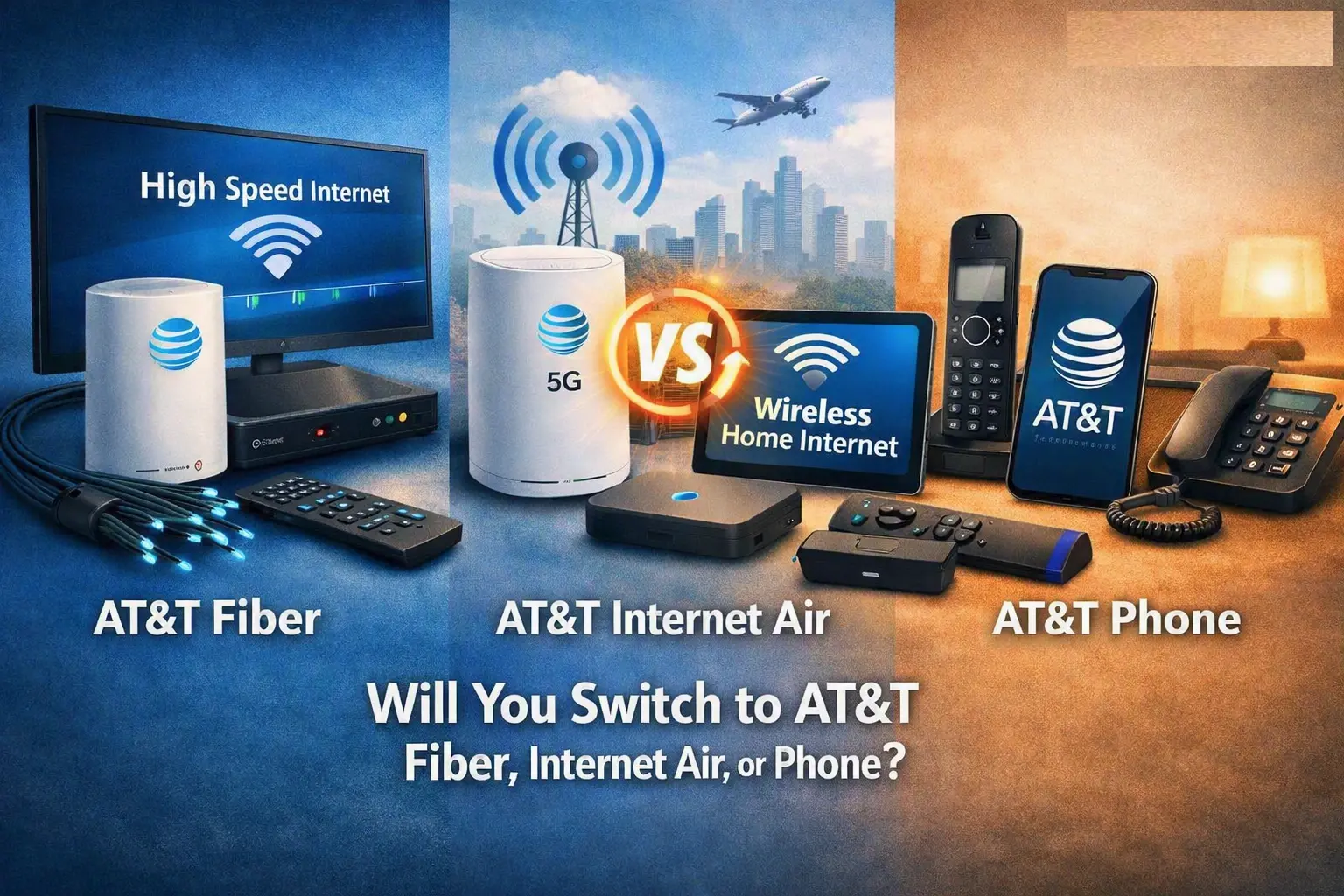
AT&T Fiber is the strongest choice for anyone who can get it: symmetrical speeds from 300 Mbps up to 5 Gbps, prices from roughly $35–$95/mo depending on tier and bundling, no data caps, no annual contract, and a rate that doesn't jump after 12 months.
AT&T Internet Air is the right fallback where fiber isn't built yet — fixed wireless 5G home internet priced around $60/mo standalone (lower with an eligible wireless plan), with unlimited data but more variable speeds since it depends on cellular network capacity.
AT&T Phone is a separate decision: it's a digital home phone service (around $24.99/mo when bundled with AT&T Internet) built to replace a traditional landline, which AT&T is actively phasing out — copper landline service is being retired in multiple states, with a full network shutdown targeted for 2029. Most switching households end up choosing Fiber or Internet Air for connectivity, and deciding on AT&T Phone separately based on whether they still need a dedicated home phone line.
Introduction
AT&T's home services lineup can be genuinely confusing, because "AT&T Fiber," "AT&T Internet Air," and "AT&T Phone" aren't competing versions of the same product — they solve three different problems. Fiber is wired broadband. Internet Air is a fixed-wireless internet substitute for homes without fiber access. AT&T Phone is a digital home phone service that rides on top of an internet connection, replacing a traditional copper landline. The real question most households are asking isn't "which one is best," but "which of these do I actually need, and can I combine them?"
This guide breaks down each service on its own terms — pricing, speed, reliability, and who it's actually built for — so switching decisions are based on what fits the household, not just what AT&T is currently promoting.
Key Findings
AT&T Fiber pricing changed as of June 7, 2026: the 100 Mbps tier was discontinued, and the 300 Mbps plan dropped to as low as $35/mo with an eligible wireless bundle.
AT&T Internet Air is priced around $60/mo standalone, or as low as $47/mo with an eligible AT&T unlimited wireless plan — both AT&T Fiber and Internet Air include unlimited data with no overage charges.
AT&T Fiber's pricing model locks in the rate at sign-up rather than using a promotional-rate-then-hike structure common among cable competitors.
Traditional AT&T copper landline service is being actively phased out, with formal discontinuation notices already sent in states including Illinois, Ohio, and Michigan, and a full copper network shutdown targeted for 2029.
AT&T Phone (digital voice, running over an internet connection) is the forward-compatible replacement for a landline, generally priced around $24.99/mo when bundled with AT&T Internet — separate from AT&T Phone – Advanced, a cellular-backed option built for households needing battery-independent 911 access.
AT&T Fiber: the best option where it's available
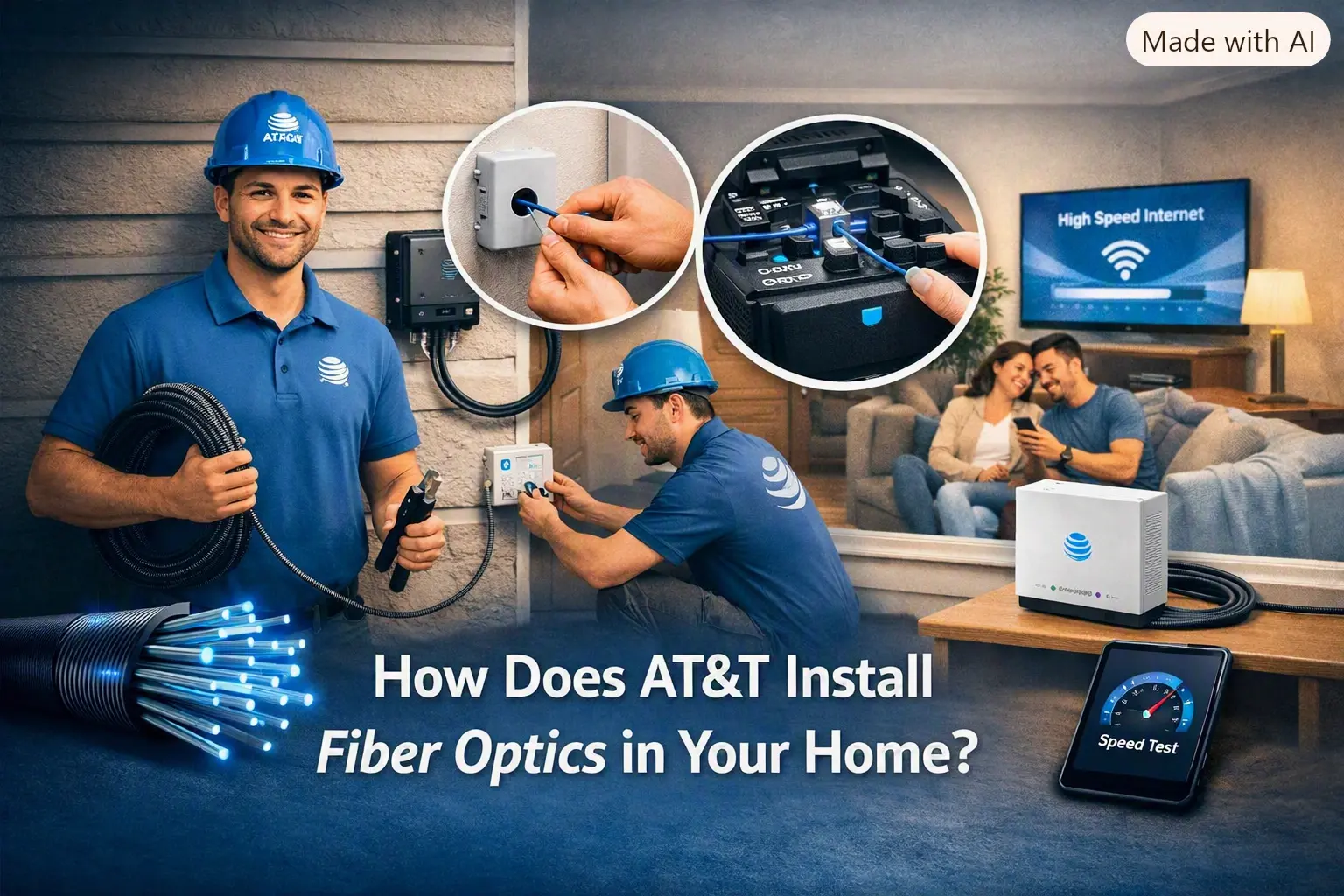
AT&T Fiber is a true fiber-to-the-home connection, which means symmetrical upload and download speeds — a meaningful advantage over cable internet, where uploads typically lag far behind downloads. Plans scale from 300 Mbps up to a 5 Gig residential tier, and as of the June 2026 pricing changes, the 300 Mbps tier can run as low as $35/mo when bundled with an eligible AT&T wireless line.
Fiber also comes with no data caps and no annual contract, and AT&T's pricing structure locks in the rate at signup rather than hiking it after an introductory period — a real differentiator from cable providers that commonly raise prices after 12 months. The catch is availability: AT&T Fiber currently covers a meaningful but still limited footprint (roughly 21 states), so it's simply not an option everywhere.
AT&T Internet Air: the fallback where fiber isn't built yet
Where fiber hasn't reached a home, AT&T Internet Air fills the gap using fixed wireless 5G instead of a wired connection. It's simple to set up — a self-install gateway rather than a technician visit — and it includes unlimited data with no caps, matching Fiber on that front. Pricing runs about $60/mo standalone, or as low as $47/mo with an eligible AT&T unlimited wireless plan. The tradeoff is consistency: because Internet Air depends on cellular network capacity, speeds can fluctuate more than a wired fiber connection, and AT&T reserves the right to temporarily reduce speeds during network congestion. For most households, Internet Air is best understood as "the good option when fiber isn't available yet," rather than a direct fiber competitor — and AT&T explicitly allows customers to upgrade from Internet Air to Fiber later if fiber becomes available at their address.
AT&T Phone: a separate decision about your home phone line
AT&T Phone is a digital home phone service that uses an existing AT&T internet connection to carry calls, distinct from AT&T's legacy copper landline. It's generally priced around $24.99/mo when bundled with AT&T Internet, and represents the forward-compatible option as AT&T retires copper infrastructure nationwide. There's also AT&T Phone – Advanced, a version powered by the AT&T cellular network with battery backup, designed for households — often older adults or those in areas prone to power outages — who need a home phone that keeps working without home internet or grid power.
Traditional AT&T landline service is still technically available to existing customers in a shrinking number of areas, priced noticeably higher (commonly cited in the $51–$77/mo range), but AT&T has already begun sending formal discontinuation notices in several states, with a full copper shutdown targeted for 2029. Anyone still on a traditional landline should treat the migration to AT&T Phone, or a comparable VoIP alternative, as a "when," not an "if."
Should you bundle, or pick one?
Because Fiber and Internet Air both solve internet connectivity and AT&T Phone solves voice service, many households end up combining one connectivity option with AT&T Phone rather than choosing a single product. Bundling AT&T Phone with AT&T Fiber or Internet Air is typically the cheapest way to get a working home phone line, since standalone landline pricing runs significantly higher than the bundled digital voice rate. Households without any interest in a home phone line can simply choose between Fiber and Internet Air based on address availability and skip AT&T Phone entirely.
Research Insights
The bigger pattern behind this three-way comparison is that AT&T is executing a broader infrastructure transition, not just running three separate product lines. Copper retirement has accelerated meaningfully in 2026, with regulatory checkpoints already underway in states like Illinois, where residents had a formal window earlier this year to file objections to landline discontinuation. That regulatory detail matters for consumers: the shift away from copper isn't simply a marketing push toward AT&T Phone; it's tied to actual infrastructure sunsetting, with AT&T's nationwide copper shutdown targeted for 2029.
This is also why Internet Air's positioning matters more than it might first appear. It functions as a bridge technology — priced competitively enough to serve as a genuine option today, while AT&T continues expanding fiber into markets that don't have it yet. The explicit upgrade path from Internet Air to Fiber, offered at no penalty, signals that AT&T is treating fixed wireless as a placeholder for many households rather than a permanent parallel product.
Consumer Impact
The most consequential group in this comparison is households still on a traditional AT&T landline, particularly older adults and rural customers who may not realize their service has a discontinuation timeline. For them, understanding the difference between AT&T Phone (internet-dependent) and AT&T Phone – Advanced (cellular-backed with battery backup) is a genuine safety consideration, not just a pricing one — especially for anyone relying on landline reliability during power outages or in areas with weak cell signal. For everyone else, the practical impact is more straightforward: checking fiber availability at a specific address before assuming Internet Air is the only option can mean a meaningfully faster and more consistent connection for a comparable or lower price after the June 2026 pricing changes.
Future Outlook
Expect AT&T's fiber build-out to keep expanding through the rest of 2026 and beyond, gradually shrinking the number of addresses that need to rely on Internet Air as a primary connection. On the voice side, the copper retirement timeline will likely accelerate further as AT&T works toward its 2029 shutdown target, with more states following Illinois, Ohio, and Michigan in receiving formal discontinuation notices. Bundled pricing that ties wireless, fiber, and phone service together is also likely to keep expanding, since AT&T's current pricing structure already rewards customers who consolidate multiple services under one account.
Research Methodology
This article is based on AT&T's current published pricing and plan details for Fiber, Internet Air, and Phone/Phone – Advanced as of August 2026, including AT&T's June 2026 fiber pricing changes, alongside independent broadband and home-phone comparison coverage. Pricing reflects standard advertised rates at the time of research and can vary by address, market, and eligible bundling; availability is not guaranteed in all areas.
FAQ
What's the difference between AT&T Fiber and AT&T Internet Air?
AT&T Fiber is a wired fiber-optic connection with symmetrical speeds up to 5 Gbps; AT&T Internet Air is fixed wireless 5G home internet used where fiber isn't available. Fiber is generally faster and more consistent; Internet Air is easier to install and works as a fallback.
Is AT&T Internet Air a good permanent replacement for Fiber?
It can be, especially with unlimited data and no contract, but speeds can fluctuate more than fiber since it depends on cellular network capacity. AT&T allows customers to upgrade to Fiber at no penalty if it later becomes available at their address.
What is AT&T Phone, and is it the same as a landline?
AT&T Phone is a digital home phone service that runs over an AT&T internet connection, replacing the need for a traditional copper landline. It is not the same as AT&T's legacy Landline product, which is being phased out.
Is AT&T shutting down landline service?
Yes, gradually. AT&T has been retiring copper landline infrastructure across multiple states, sending formal discontinuation notices to customers, with a full nationwide copper network shutdown targeted for 2029.
What is AT&T Phone – Advanced, and who needs it?
It's a version of AT&T Phone powered by the AT&T cellular network with battery backup, built for households that need a home phone to keep working without home internet or grid power — often recommended for older adults or people in outage-prone areas.
Can I bundle AT&T Fiber or Internet Air with AT&T Phone?
Yes. Bundling AT&T Phone with AT&T Fiber or Internet Air is typically the most affordable way to add a home phone line, generally cheaper than AT&T's remaining traditional landline pricing.
How do I know if AT&T Fiber is available at my address?
Availability depends on AT&T's current fiber build-out, which varies significantly by city and state. Checking directly with a provider or an AT&T representative is the most reliable way to confirm current availability and pricing at a specific address.
Conclusion
AT&T Fiber, Internet Air, and AT&T Phone aren't really competing against each other — they're answers to three different questions: how do I get the fastest wired internet, what do I use if fiber isn't available yet, and how do I keep a working home phone as copper landlines get phased out. The right combination depends on address availability and whether a dedicated home phone line still matters to the household. Readers weighing these options, or trying to confirm what's actually available at their address, can find more AT&T and provider comparisons at CablePapa.com or speak with a representative at (844) 905-5001 to check current pricing and availability.