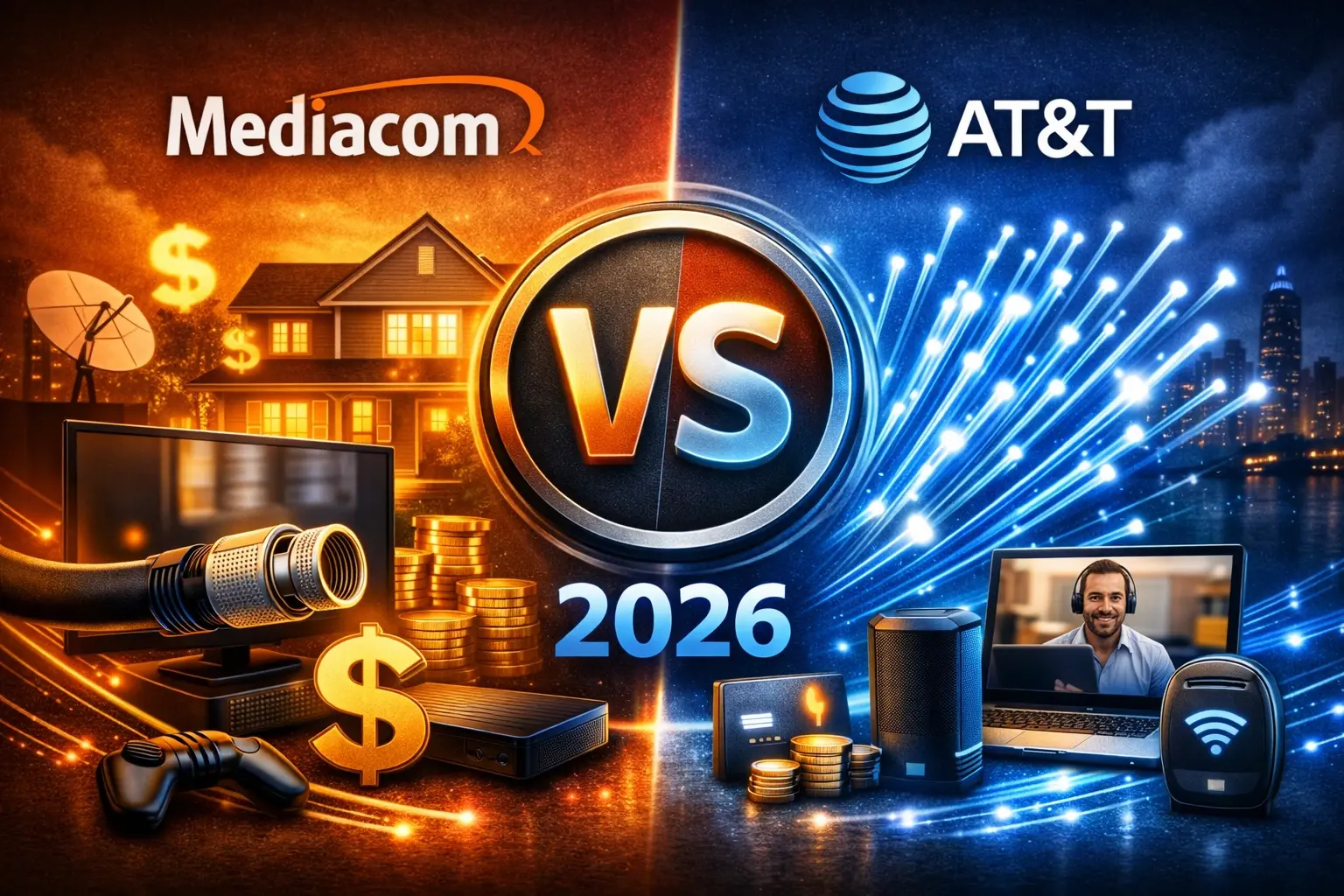
Mediacom and AT&T represent two very different approaches to home internet. Mediacom is a regional cable operator built around affordable introductory pricing in the Midwest and South. AT&T is a national carrier whose fiber network has expanded aggressively in recent years, now reinforced by its 2026 acquisition of fiber assets from Lumen Technologies. The two providers rarely compete directly — their footprints overlap in a small fraction of the country — but for households that can get both, the comparison is one of the more consequential ones in residential broadband: cable's low starting price against fiber's price stability and unlimited data.
This article compares Mediacom and AT&T using current 2026 pricing data, FCC broadband labels, and independent satisfaction research to help households understand what they're actually choosing between, beyond the advertised "starting at" rate.
Quick Answer
Where both are available, AT&T Fiber is the stronger long-term choice for most households. It offers symmetrical upload and download speeds, no data caps on any fiber plan, no annual price increases, and consistently higher customer satisfaction scores. Mediacom's advantage is narrower but real: its entry-level promotional pricing is often cheaper in the first one to two years, and it remains the primary wired broadband option across large parts of the rural Midwest and South where AT&T Fiber simply isn't built out. The right choice mostly comes down to availability — AT&T Fiber reaches a much smaller share of U.S. addresses overall, but where it exists, it tends to outperform Mediacom on nearly every metric that matters over time.
Key Findings
Coverage overlap is minimal. AT&T Fiber is available in 21 states, concentrated in metro and suburban areas, reaching an estimated 27–30 million locations nationally. Mediacom serves roughly 22 states, concentrated in smaller Midwest and South markets, with a materially smaller overall footprint. Independent comparison data puts the direct overlap between the two providers at a small fraction of either company's total service area.
Pricing philosophy differs sharply. Mediacom's Internet 300 plan starts around $30/month with a promotional lock, but standard rates after the promotional window can climb toward $90–$110/month. AT&T Fiber's comparable Internet 300 plan starts around $55/month (after autopay discount) with no scheduled price increase — the rate quoted at signup is designed to be the rate paid long-term.
Data caps are a defining difference. Mediacom applies data caps ranging from roughly 200 GB to 1,500 GB depending on plan tier, with overage charges for exceeding the limit. AT&T Fiber applies no data caps on any of its fiber plans.
Upload speed is not a contest. AT&T Fiber delivers fully symmetrical speeds — a 1 Gig plan means 1 Gbps up and down. Mediacom's cable plans are asymmetric, with upload speeds typically capping out around 35–200 Mbps depending on tier, even on its fastest download plans.
Customer satisfaction favors AT&T by a wide margin. In 2026 ACSI data, AT&T Fiber posted a leading score among fiber providers, while Mediacom's ACSI-tracked score (under its Xtream brand) landed well below it. J.D. Power and Consumer Reports data show a similar pattern, with Mediacom consistently ranking in the bottom third of national providers and AT&T Fiber scoring above the industry average.
Contract terms are comparable. Neither provider requires an annual contract on standard residential plans, so both allow cancellation without early termination fees.
Main Analysis
Mediacom vs. AT&T: Plans and Pricing
Mediacom's Xtream lineup is built around aggressive short-term promotions. Its Internet 300 plan is commonly advertised around $30/month with a two-year price lock, and its gigabit tier is priced competitively against other cable providers during the promotional period. The catch, well-documented across independent reviews, is what happens afterward: standard rates on Mediacom plans can roughly double once the promotional period lapses, and the company has historically been less transparent about disclosing that eventual rate at the point of signup.
AT&T Fiber takes the opposite approach. Its current lineup — Internet 300, 500, 1 GIG, and 5 GIG — starts around $55/month after standard discounts, with AT&T explicitly marketing flat-rate pricing that doesn't increase after 12 months the way cable promotional pricing typically does. The trade-off is that AT&T's entry price is higher than Mediacom's promotional entry price, so a household evaluating only year-one cost may find Mediacom cheaper — but that gap typically closes or reverses by year two.
Mediacom vs. AT&T: Data Caps and Network Type
This is arguably the most consequential practical difference between the two providers. Mediacom's data caps vary by tier, with lower-tier plans historically capped as low as 200–600 GB per month and its gigabit tier capped higher (reported around 1,500 GB in some markets), with per-GB overage charges for households that exceed their allowance. AT&T Fiber, by contrast, applies no data cap to any of its fiber plans — a policy AT&T has held consistently as a competitive differentiator against cable providers.
The technology underneath also matters. Mediacom is a cable provider running DOCSIS infrastructure, which inherently delivers asymmetric speeds — fast downloads, much slower uploads. AT&T Fiber is fiber-to-the-home, delivering matching upload and download speeds on every tier. For households doing video calls, cloud backups, content creation, or remote work that depends on consistent upload bandwidth, this is a structural advantage fiber has that cable technology cannot fully replicate, regardless of how a specific cable provider prices its plans.
Mediacom vs. AT&T: Customer Satisfaction and Reliability
Independent satisfaction research consistently favors AT&T. In 2026 ACSI telecommunications data, AT&T Fiber posted a leading score among fiber internet providers nationally. Mediacom, tracked in ACSI's non-fiber category under its Xtream brand, scored meaningfully lower. Consumer Reports' survey data has placed Mediacom near the bottom of its rankings for value and customer service specifically, while independent aggregators like BroadbandNow have consistently scored AT&T higher than Mediacom in direct customer-review comparisons.
Part of this gap likely reflects the underlying business model rather than service quality alone: promotional pricing that expires into a much higher rate is one of the most common drivers of ISP dissatisfaction across the industry, and it's a pattern more associated with cable providers like Mediacom than with AT&T's current flat-rate fiber approach.
Research Insights
The Mediacom-versus-AT&T comparison is really a case study in two different philosophies competing for the same broadband dollar. Mediacom's model — low promotional pricing, tiered data caps, and price increases after the introductory period — is built to win the first-year price comparison and rely on switching friction to retain customers afterward. AT&T's current fiber pricing strategy is built to win the multi-year comparison by removing the two variables (data caps and scheduled rate increases) that most reliably erode customer satisfaction over time.
This divergence also explains why AT&T's expansion strategy matters more than it might first appear. AT&T's 2026 acquisition of Lumen's fiber assets — which folded former Quantum Fiber and CenturyLink fiber customers into the AT&T Fiber brand — signals a broader industry shift toward consolidating fiber footprints to compete more directly with cable incumbents like Mediacom in markets where fiber previously wasn't a realistic option. Over the next several years, this kind of consolidation is likely to shrink the number of addresses where Mediacom remains the only viable wired option, which historically has been the core of its customer base.
That said, Mediacom's continued relevance in smaller Midwest and South markets isn't just a pricing story — it reflects a genuine infrastructure gap. Fiber buildout is capital-intensive and slower in lower-density areas, and cable incumbents like Mediacom often remain the only realistic wired alternative to DSL or satellite in these markets for years after fiber becomes standard in nearby metros.
Consumer Impact
For households evaluating these two providers, the practical guidance breaks down as follows:
If AT&T Fiber is available at your address: It's the stronger long-term option for the vast majority of households, particularly anyone doing remote work, video calls, cloud backups, or heavy streaming, due to symmetrical speeds, no data caps, and flat-rate pricing.
If you're strictly optimizing for the lowest possible first-year cost: Mediacom's promotional pricing can beat AT&T's entry price, provided you're prepared for a significant rate increase after the promotional period and are mindful of your plan's data cap.
If your household is a heavy data user (streaming, gaming, multiple 4K devices, large uploads): AT&T Fiber's lack of data caps removes a real risk that exists with several of Mediacom's lower and mid-tier plans.
If AT&T Fiber isn't available at your address: Mediacom remains a legitimate, often necessary option in its core Midwest and South markets, particularly where the realistic alternative is DSL or satellite rather than another fiber or cable competitor.
If remote work or video calls are a daily requirement: AT&T's symmetrical upload speeds are a meaningful practical advantage that no Mediacom plan can fully match, given the underlying limitations of cable technology.
Households unsure which of the two actually serves their address, or who want current promotional pricing compared side by side, can check availability and get personalized guidance at cablepapa.com or by calling (855) 210-8090.
Future Outlook
AT&T's fiber expansion shows no sign of slowing. Between organic buildout commitments and the 2026 Lumen fiber asset acquisition, AT&T has stated intentions to keep growing its footprint by several million locations per year, which will likely bring fiber competition into more of the smaller and mid-sized markets that have historically been Mediacom's stronghold. AT&T has also begun rolling out AI-driven Wi-Fi management and multi-gig tiers (up to 5 Gbps) in select fiber markets, further widening the technology gap with cable-based competitors.
Mediacom, for its part, has signaled plans to modernize its own network with DOCSIS 4.0 and expanded 10 Gbps-capable infrastructure over the coming years, which could eventually narrow the upload-speed and reliability gap with fiber. Whether that modernization keeps pace with AT&T's fiber expansion in Mediacom's core markets will likely determine how much competitive pressure the company faces over the next several years — and whether it can afford to reconsider some of the pricing and data-cap practices that currently separate it from higher-satisfaction competitors.
Frequently Asked Questions
Is AT&T better than Mediacom overall?
In markets where both are available, AT&T Fiber generally outperforms Mediacom on price stability, data caps, upload speed, and customer satisfaction. Mediacom's main advantage is often a lower promotional starting price and availability in markets AT&T Fiber doesn't reach.
Does Mediacom have data caps?
Yes. Mediacom applies data caps that vary by plan tier, generally ranging from roughly 200 GB on lower tiers up to around 1,500 GB on its gigabit plan, with overage fees for exceeding the limit.
Does AT&T Fiber have data caps?
No. AT&T Fiber includes unlimited data on all of its fiber plans, with no overage charges regardless of usage.
Why does Mediacom's price increase after the first year?
Like most cable providers, Mediacom uses promotional introductory pricing to attract new customers, with rates reverting to a higher standard rate after the promotional period (typically 12 to 36 months) ends. This is standard industry practice, though the size of Mediacom's increase has drawn particular criticism in independent reviews.
Is AT&T Fiber available everywhere Mediacom is?
No. AT&T Fiber's footprint (21 states, concentrated in metro and suburban areas) is smaller than Mediacom's overall footprint (22 states, concentrated in smaller Midwest and South markets), and the two providers directly overlap in only a small share of their combined coverage areas.
Which provider is better for remote work?
AT&T Fiber, primarily because of its symmetrical upload speeds. Mediacom's cable-based upload speeds are asymmetric and generally much lower than its download speeds, which can be a bottleneck for video calls, large file uploads, and cloud-based work tools.
Do either providers require contracts?
No. Both Mediacom and AT&T offer contract-free residential internet, meaning customers can cancel without early termination fees, though Mediacom's promotional pricing is still tied to a fixed time window regardless of contract status.
How do I find out which provider is available at my address?
Since the two providers rarely overlap, availability is the deciding factor for most households. The most reliable way to check current options and pricing is by address through a resource like cablepapa.com or by speaking with a plan specialist at (855) 210-8090.
Conclusion
Mediacom and AT&T rarely compete for the same customer, but the comparison is still useful because it illustrates two very different broadband philosophies: cable's low-entry, high-exit pricing model versus fiber's flat-rate, no-caps approach. Where AT&T Fiber is available, it's generally the stronger long-term choice on nearly every measurable dimension — price stability, data policy, upload speed, and customer satisfaction. Where it isn't, Mediacom remains a legitimate and often necessary option, particularly across the Midwest and South markets where it continues to serve as the primary wired alternative to DSL. The deciding factor for most households will be availability first, and total multi-year cost second.