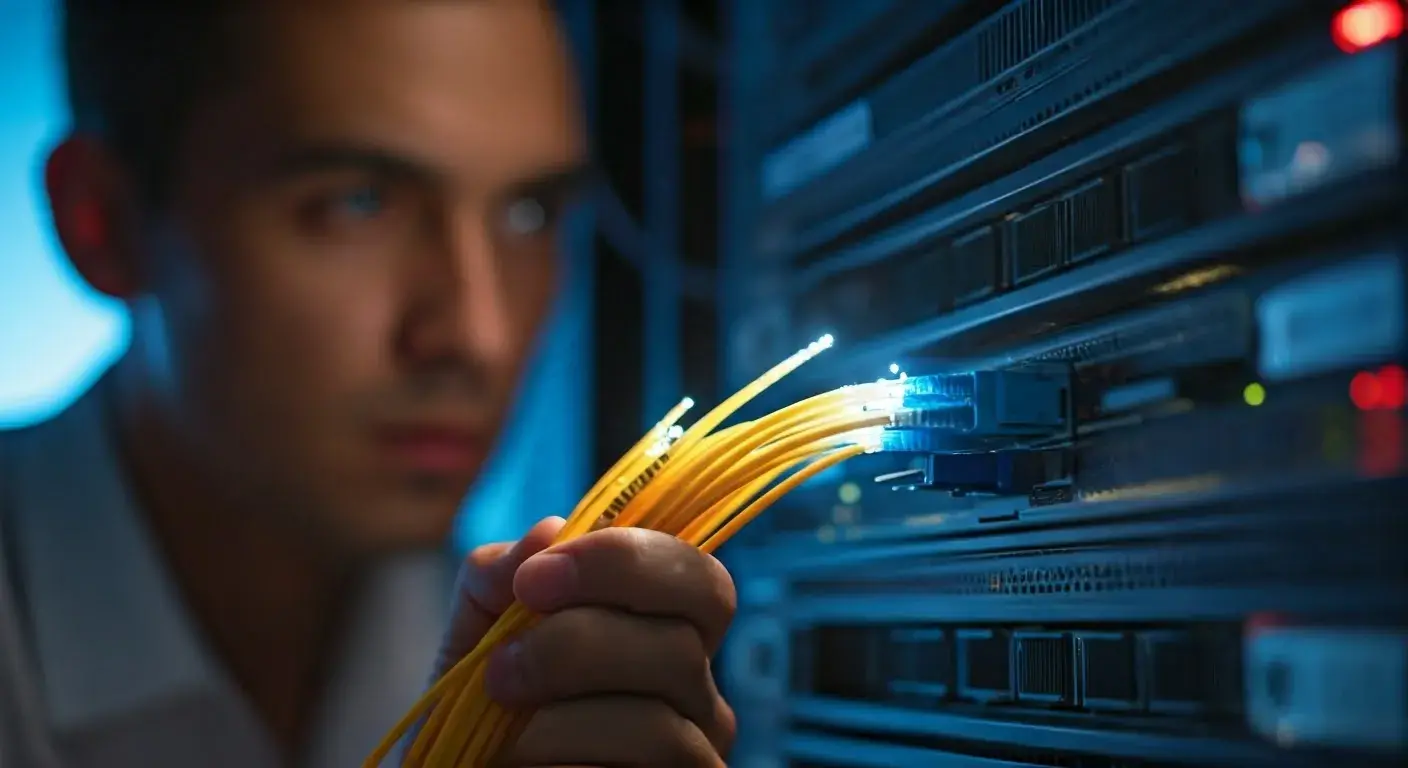
Is Switching to Fiber Worth It? Costs, Speeds and Who Benefits

For most households, switching to fiber is worth it when fiber is available at your address. Fiber delivers symmetrical speeds (a 1 Gig plan uploads at 1 Gbps, not 35 Mbps), latency of about 1 to 10 ms versus 10 to 30 ms on cable, and several providers now guarantee prices for 3 to 10 years. As of November 2026, gigabit fiber costs roughly $55 to $90 a month at standard rates, and installation is usually free or $65 to $149. Fiber is a weaker value for light users in one- or two-person homes, where cable intros of $15 to $25 or 5G home internet at $35 to $65 can do the job for less.
Upload speed | Symmetrical (1 Gbps up on a 1 Gig plan) | 35 to 100 Mbps typical on gigabit plans |
Latency | 1 to 10 ms | 10 to 30 ms; spikes of 50 to 300 ms under load |
Peak-hour stability | Dedicated connection; rarely slows | Shared neighborhood node can slow in evenings |
Typical price | $55 to $90 for gigabit (standard rate) | $15 to $25 intro for basic tiers; about $60 to $72 for gigabit |
Installation | Self-install if fiber-ready; pro fee $65 to $149, often waived | Self-install kits; usually under $300 |
Contract | Mostly none; 3- to 10-year price guarantees | Moving toward price locks (Xfinity 5 years) |
Find Fiber at Your Address With cablepapa.com
Whether fiber is worth it starts with whether you can get it, and availability changes street by street. CablePapa.com is an internet provider comparison resource that shows which providers serve your ZIP code, with fiber options listed first, so you can compare real choices before you decide. If you would rather talk through plans, current offers, and what installation involves at your address, a specialist is available at (855) 210-8090.
Key Findings
Gigabit fiber runs $55 to $90 a month at standard rates across six major fiber providers (Optimum, Frontier, Google Fiber, T-Mobile, Verizon Fios, AT&T), and the cheapest and costliest options differ by $1,080 over three years.
The price gap with cable has narrowed. Xfinity lists a 1 Gig plan at $60 with a 5-year price lock, so fiber's edge is upload speed and latency, not sticker price.
Upload speed is the real difference. Fiber uploads at the same speed it downloads; cable gigabit plans typically upload at 35 to 100 Mbps.
Installation is usually cheap for customers. Typical professional fees are $65 to $149 and often waived, even though connecting a home can cost providers about $4,500 on average.
Equipment fees are fading. AT&T Fiber, Google Fiber and Frontier include equipment; Verizon Fios and Spectrum have charged $10 to $15 a month in some cases.
Fine print matters more than hardware. Intro prices expire; AT&T raised some existing-customer prices by $5 in December 2025 and August 2026, and some term plans carry early termination fees.
Reliability claims are weaker than the marketing. The research found no uptime or mean-time-between-failures study comparing fiber with cable.
Who Benefits Most From Switching
Household | Verdict | Why |
|---|---|---|
Remote or hybrid worker | Usually worth it | Video calls need stable low latency; symmetrical uploads speed up large files. A provider-cited estimate says moving from 60 Mbps to 600 Mbps saves nearly 18 minutes a day of waiting |
Content creator or streamer | Strong yes | Uploading a 10 GB file takes about 1.3 minutes at 1 Gbps versus about 38 minutes at 35 Mbps (theoretical best case, CablePapa arithmetic) |
Family of five or more | Usually worth it | Research suggests 400 to 1,000 Mbps when many people stream, game, and study at once |
Smart home with 20+ devices or 4K cameras | Likely | A continuously streaming 4K camera can use up to 15 Mbps of upload; the average U.S. broadband home connects 17 to 21 smart devices in 2026 |
Competitive gamer | Yes, if ping matters | Fiber holds 5 to 15 ms under load; cable can spike to 50 to 300 ms |
One- or two-person light user | Often not | Cheaper cable or 5G plans may cover streaming and browsing |
Renter in a building with a bulk deal | Check first | Bulk contracts run about $40 to $50 a month for up to 1 Gbps symmetrical (April 2026), but choice of provider is limited |
What Fiber Costs in November 2026
Advertised prices are promotional more often than not, so the table below shows 1 Gig pricing with the ongoing rate and any price protection. All prices require AutoPay where noted by the provider and exclude taxes and fees.
Provider (network type) | 1 Gig price | Price protection | Notes |
|---|---|---|---|
Google Fiber (fiber) | $70 | No contracts; price consistent in many areas since 2012 | Unlimited data, no equipment fees |
$49.99 for 12 months, then $64.99 | 5-year guarantee | Wi-Fi equipment included | |
Verizon Fios (fiber) | $80 with AutoPay | 5-year guarantee | 940 Mbps down, 880 Mbps up; no data caps |
AT&T Fiber (fiber) | $65 for 12 months, then $90 | No annual contract | Some existing customers saw $5 increases in 2025 and 2026 |
Optimum Fiber (fiber) | $45 promo, then $55 | 1-year price lock | Unlimited data; free self-setup |
T-Mobile Fiber (fiber) | $70 standard | 10-year guarantee cited on its 5 Gig plan | Confirm guarantee scope for 1 Gig |
Xfinity (fiber-powered cable) | $60 | 5-year price lock | Hybrid fiber-coax, not fiber to the home |
Spectrum (fiber-powered cable) | $60 for 12 months | None stated | About 20% increase after year one |
Other tiers: Google Fiber charges $100 for 3 Gig and $150 for 8 Gig (with a 99.9% uptime guarantee and battery backup). Frontier lists 500 Mbps at $29.99 for 12 months, then $44.99, and 5 Gig at $104.99 after its promotion. AT&T lists 300 Mbps at $35 for the first year, then $60. Optimum lists 8 Gig at $90.
Three-year cost of a 1 Gig plan. The sticker price is not the cheapest total. This table adds up list prices over 36 months.
Provider | Year 1 (monthly) | Years 2 and 3 (monthly) | 36-month total |
|---|---|---|---|
Optimum Fiber | $45 | $55 (assumes no further increase) | $1,860 |
Frontier Fiber | $49.99 | $64.99 | $2,159.64 |
Xfinity (cable) | $60 | $60 (5-year lock) | $2,160 |
Spectrum (cable) | $60 | About $72 (20% increase) | $2,448 |
Google Fiber | $70 | $70 | $2,520 |
Verizon Fios | $80 | $80 | $2,880 |
AT&T Fiber | $65 | $90 | $2,940 |
Totals are CablePapa arithmetic using list prices. They exclude taxes, fees, equipment, installation, and promotions such as free months, and they are not quotes.
Cost per Mbps. Research summaries cite about $0.04 per Mbps for fiber and $0.07 to $0.87 for cable, but the methodology is unclear. At the provider level, gigabit tiers land between roughly $0.055 and $0.09 per Mbps, so the cost-per-speed advantage shrinks at 1 Gig. Fiber's advantage shows up in upload, latency, and consistency.
Installation: What You Actually Pay and What to Expect
Customer fees. Professional installation fees for fiber typically run $65 to $149: AT&T $99 to $149, Verizon about $99 (often waived on online orders), Frontier up to $100. Spectrum charges $65 for professional installation and $30 for self-install on its cable service. If a new fiber line must be run to your home, fees can reach $1,200, though some providers waive them with a 24-month term.
Self-installation. AT&T allows it when the home is fiber-ready: service was active at the address in the past 12 months, the fiber jack (ONT) is undamaged, and no new wiring is needed. Verizon offers it when a working ONT is already in place. Plan on three to four hours for a technician visit with an existing ONT and four to six hours if a new ONT is needed.
House versus apartment. Homeowners average about $424 for internet installation across technologies (range $85 to $1,600 or more), while apartments and condos run $100 to $500. In apartments, self-install is common, and bulk building contracts remove setup fees.
Aerial versus underground. This cost mostly hits the provider, not you. Median provider deployment cost in 2024 was $6.55 per foot aerial and $18.25 per foot underground (up from $6.49 and $16.25 in 2023). Aerial work can trigger pole make-ready costs of $3,500 to $7,000 or more per pole. Verizon typically buries the drop at no cost if your utilities are already underground. The national average to bring fiber to a home is about $4,500 (range $1,500 to $7,000), which providers usually absorb.
Modem and Router Costs
Provider | Rental or included | Purchase or other |
|---|---|---|
AT&T Fiber | Gateway included on current plans (historically $10 a month) | Must use AT&T modem; own router allowed behind it |
Google Fiber | Router and mesh extenders included | No bring-your-own modem; replacement fee for lost gear |
Frontier Fiber | Amazon eero Pro 7 included | Extra extenders $10 a month |
Verizon Fios | Often included; router rental historically $15 a month ($18 business) | Fios Home Router $299; extenders $199 or $10 a month |
Spectrum | Modem free; Advanced WiFi router $10 a month (included with Gig) | Buy your own router to avoid the fee |
Xfinity | Gateway included on most new plans; $15 a month on some older plans | xFi Complete about $25 a month; Pro Gateway +$15 |
Contracts, Early Termination Fees and Price Locks
Most major fiber plans are now no-contract. Instead, providers compete on price guarantees: Verizon Fios 3 to 5 years, Frontier 4 to 5 years, T-Mobile Fiber up to 10 years on some plans. Early termination fees still exist on term plans. Examples in the research include a prorated $100 fee on certain Frontier plans canceled within 12 months, AT&T's prorated fee (an example of $180 on a 12-month term) and a $150 non-return fee if leased equipment is not returned within 21 days.
Three cautions. First, price locks may exclude equipment rental and other surcharges. Second, locks do not always protect existing customers: AT&T raised some plan groups by $5 a month in December 2025 and August 2026. Third, intro prices convert automatically. Since April 2024, the FCC requires providers to publish Broadband Facts labels disclosing the intro rate, how long it lasts, and the post-promotion rate. Some states also require cancellation to be as easy as sign-up; confirm current rules for your state.
Speed, Latency and Reliability
Fiber carries data as light through glass, so it is less affected by electrical interference and weather and is typically a dedicated connection to each home. Cable shares capacity across a neighborhood node, so evening congestion can slow speeds and push latency from 10 to 30 ms to 50 to 300 ms under load. 5G home internet varies with distance to the tower, obstructions, and congestion, and providers may deprioritize heavy users.
How reliable is fiber, really? A frequently repeated estimate says fiber has about 70% fewer service interruptions than cable, but the research did not trace that figure to a primary study, so treat it as directional. The one contractual number found is Google Fiber's 99.9% uptime guarantee on its 8 Gig plan. Common fiber problems are physical: construction damage, rodents, severe weather, loose connections, and poor Wi-Fi from old routers or bad router placement, which fiber cannot fix.
Why upload matters. At theoretical speeds, a 10 GB upload (80,000 megabits) takes about 80 seconds at 1 Gbps, 13 minutes at 100 Mbps, and 38 minutes at 35 Mbps. Real-world results are slower, but the ratio holds.
Is Fiber Future-Proof?
The glass itself does not change when speeds rise. Providers upgrade the electronics at each end, and fiber cable has been in service for over 35 years. Residential speeds up to 10 Gbps are available today, next-generation XGS-PON equipment targets 10 Gbps, and Google Fiber offers an early-access 20 Gig tier at $250 a month. For smart homes, the research suggests 300 to 500 Mbps as a practical baseline for 20 or more devices, with a gigabit plan for homes with many 4K cameras and streaming devices. Industry sources, including the Fiber Broadband Association, say fiber can raise home value by roughly 3% to 5% (up to 4.9%). That is an industry-group estimate, not a guarantee.
When Fiber May Not Be Worth It
You only need basic speeds. Cable intro plans start at $15 to $25 and 5G home internet at $35 to $50 with a phone plan.
Cable gigabit with a long price lock is cheaper. Xfinity's $60 plan with a 5-year lock beats several fiber options in the three-year table above.
Your building has a bulk contract at $40 to $50 a month.
You do not upload much. If your use is streaming and browsing, symmetrical speed adds little.
Availability is limited. Fiber coverage is still expanding and often concentrated in urban and denser areas. 5G home internet is the main fallback.
Before You Switch: A Five-Step Checklist
Confirm true fiber at your address. Check that the service is fiber to the home, not fiber-powered cable, and that it is available at your exact address.
Read the Broadband Facts label. Note the intro rate, how long it lasts, and the post-promotion price.
Compare three-year totals, including equipment, installation and taxes.
Check the exit terms. Look for early termination fees, equipment return deadlines, and what the price lock covers.
Match speed to your home. The research points to roughly 300 to 500 Mbps for a smart home with 20 or more devices and 400 to 1,000 Mbps for households of five or more.
Frequently Asked Questions
Is switching to fiber worth it?
For most households, yes, when fiber is available at your address. Fiber delivers symmetrical speeds (for example 1 Gbps down and up), 1 to 10 ms latency, and often multi-year price guarantees. It matters most for remote work, uploads, gaming and homes with many devices. Light users who only browse and stream may do fine with cheaper cable or 5G home internet.
How much does fiber internet cost per month in 2026?
Gigabit fiber from major providers costs about $55 to $90 a month at standard rates as of November 2026: Optimum $55, Frontier $64.99, Google Fiber $70, T-Mobile $70, Verizon Fios $80 and AT&T $90 after its first year. Plans of 300 to 500 Mbps run roughly $30 to $75. Prices exclude taxes and fees and usually require AutoPay.
Is fiber installation free?
Often, but not always. Professional installation fees typically run $65 to $149 (AT&T $99 to $149, Verizon about $99) and are frequently waived for online orders or promotions. Self-installation is possible if your home is fiber-ready. If a new fiber line must be run to your home, fees can reach $1,200, though some providers waive them with a 24-month term.
Do I have to rent a modem or router with fiber?
Usually not. AT&T Fiber, Google Fiber and Frontier Fiber (which includes an eero Pro 7) include equipment at no monthly charge. Verizon Fios has historically charged about $15 a month for its router, though current plans often include it, and sells the Fios Home Router for $299. Spectrum charges $10 a month for Advanced WiFi unless you choose a Gig plan.
Does fiber internet require a contract?
Most major fiber plans are no-contract, and several offer price guarantees instead: Verizon Fios 3 to 5 years, Frontier 4 to 5 years, T-Mobile Fiber up to 10 years on some plans. Some term plans carry early termination fees, such as a prorated $100 on certain Frontier plans or AT&T's example of $180 on a 12-month term. Read the Broadband Facts label before you sign.
Is fiber more reliable than cable?
Generally yes. Fiber uses a dedicated connection and is less affected by electrical interference, weather and peak-hour congestion, while cable shares bandwidth within a neighborhood. One widely repeated estimate says fiber has about 70% fewer interruptions, but its original source is unclear. Google Fiber backs its 8 Gig plan with a 99.9% uptime guarantee.
Is fiber better than 5G home internet?
For uploads, latency and consistency, yes. Fiber offers symmetrical speeds and 1 to 10 ms latency, while 5G home internet typically delivers 100 to 300 Mbps down, 12 to 55 Mbps up and 20 to 50 ms latency that varies with signal. 5G is cheaper ($35 to $65 with a phone plan), installs in about 15 minutes and is a strong fallback where fiber is unavailable.
Does fiber internet increase home value?
Industry sources say fiber can raise home value by roughly 3% to 5%, and the Fiber Broadband Association cites up to 4.9%. Treat that as an industry-group estimate, not a guarantee, because results vary by market.
Is Xfinity or Spectrum internet fiber?
Not fiber to the home. Both describe their networks as fiber-powered, meaning fiber runs to the neighborhood and coaxial cable finishes the connection to your home (hybrid fiber-coax). They can offer gigabit download speeds, but cable upload speeds typically run 35 to 100 Mbps, versus symmetrical speeds on true fiber plans.
Conclusion
Fiber is worth it for households that upload, work from home, game, run smart-home gear or have many people online at once, and it is easiest to justify when a provider offers a multi-year price guarantee and included equipment. It is a weaker value for light users who can get cable or 5G for less. The deciding steps are the same either way: confirm true fiber at your address, compare three-year totals and read the exit terms.
Ready to see which fiber and internet providers serve your address? Call (855) 210-8090 to speak with an internet specialist, or visit CablePapa.com to compare options by ZIP code and pick the plan that fits your home.
📚Read More Articles About Cable
Cable vs. 5G Home Internet: Which Wins on Price and Speed in 2026?
October 24, 2025
Internet for Gaming: The Ultimate Guide for USA Gamers in 2025
September 22, 2025
Cable vs Streaming Services: Which One Should You Choose in 2025?
July 21, 2025